Wainuiomata Historical Museum Society – ex Les Dalton c1944
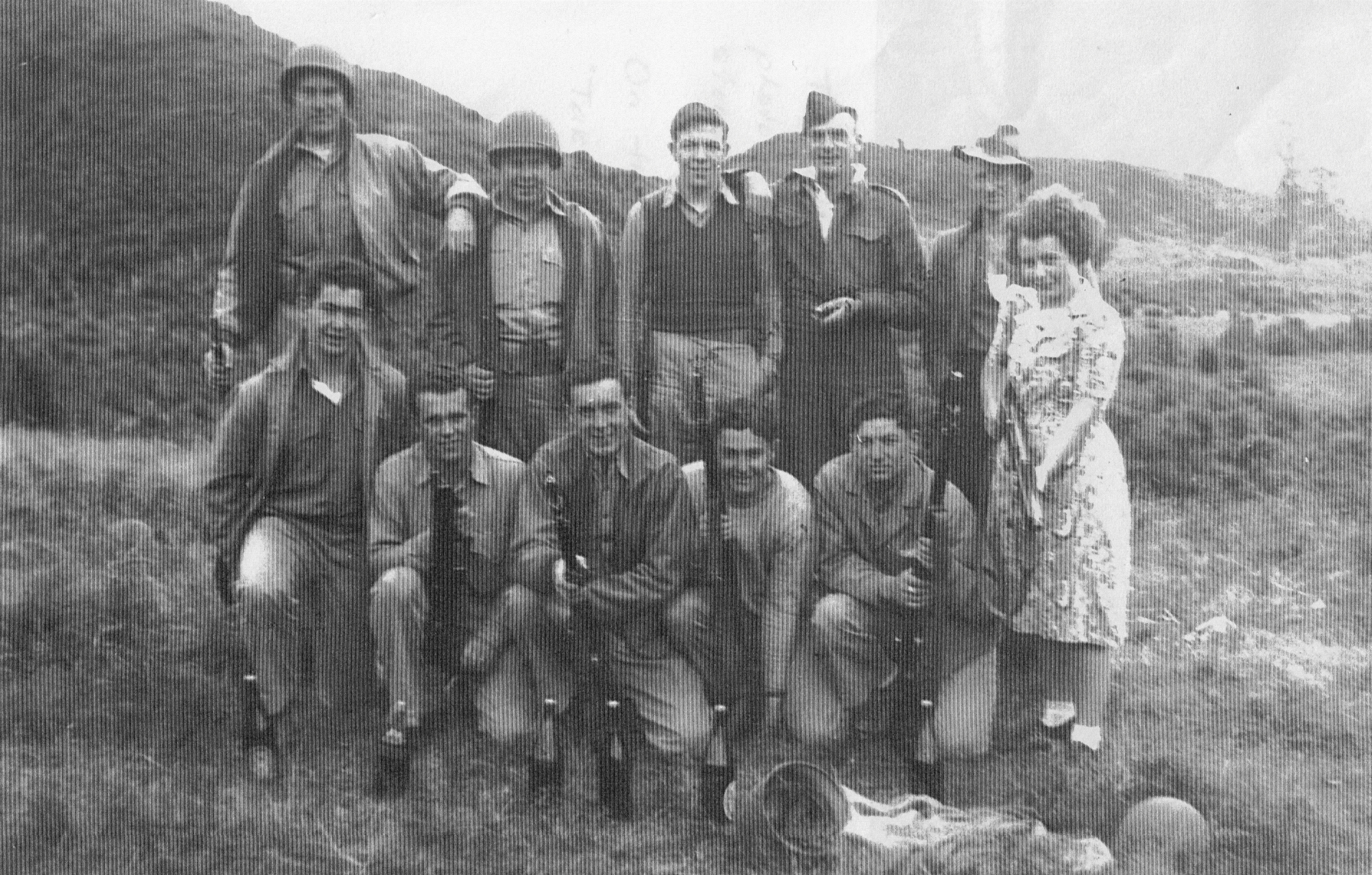
During the Second World War, Wainuiomata became a favoured escape for American servicemen stationed in the Wellington region. This photograph captures one such moment, showing a group of American GIs from Hutt Park Camp alongside local lads and Maisie Burt during a pig hunting trip in the Wainuiomata district.
At the right of the image is Maisie Burt, who is notably holding what appears to be a Thompson submachine gun. These weapons were commonly issued to US Army sergeants and were typically fitted with either 30 round box magazines or the distinctive 50 round drum magazines. With such firepower on hand, a wild pig would have needed exceptional luck to make its escape. Several beer bottles placed in front of the group suggest the hunt was as much a social occasion as it was a practical one.
The photograph may have been taken at or near Mackay’s Cottage, a well known gathering place where Mackay was reputed to host visiting servicemen. One oft repeated story from the period recounts an American officer encountering a wild pig outside the cottage and shooting it through the kitchen window.
American Marines and soldiers stationed in New Zealand between 1942 and 1944 were keen to make the most of their time off. Many used army jeeps to explore the wider Wellington region, including the Orongorongo River valley, which some Marines reportedly drove through while deer hunting. Wainuiomata was quickly discovered as a place offering both adventure and hospitality, and it became a regular destination for these informal excursions.
There was also a rifle range located in the area now known as Camp Wainui. While no written records have yet been found, its existence is consistently recalled in interviews with people who lived through that era, suggesting it played a role in local military activity.
The servicemen’s presence extended beyond hunting trips. They were frequent visitors to Claude and Madge Burdan’s farm, Willowbank, on Coast Road. Madge later recalled how the Americans would crowd around her coal range, eagerly waiting for her hot biscuits, or scones, to come out of the oven. These small domestic moments left a lasting impression and highlight the close and often warm relationship that developed between local families and the visiting servicemen.
Credits
Special thanks to Vicky Alexander for some information in this article.
Special thanks to Jeremy Foster for some information in this article.
Special thanks to Carl Smith for some information in this article.