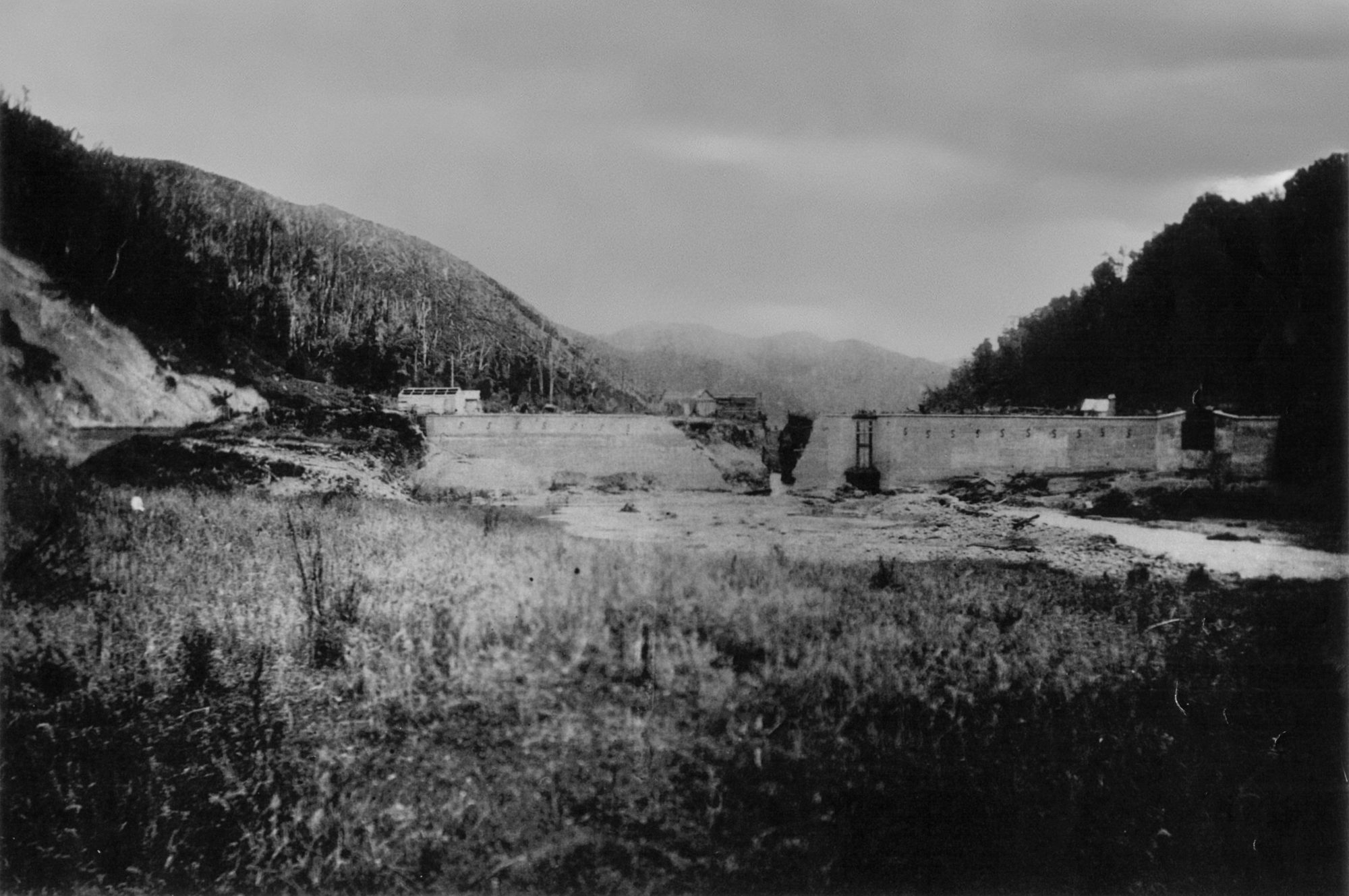
The 1883-84 floods that damage the Wainuiomata dam.
Between 1883 and early 1884, the Wainuiomata dam endured a series of destructive floods that repeatedly undermined construction works and exposed the vulnerability of the partially completed waterworks. The first major incident occurred in 1883, when heavy flooding prompted an on site inspection by members of the Wellington City Council, city officials, and representatives of the press. The purpose of the visit was to assess the extent of the damage and to decide whether the contractor, Mr G. H. Bayliss, should be granted additional time to complete the project. What they found was immediately concerning. A substantial section of the concrete face wall had been washed away by the force of floodwaters, leaving a clear gap in the dam structure. Even more damaging was the loss of the filling behind the overflow section, which had been completely scoured out before it could receive its final protective layer of boulders set in cement. This work was reportedly close to completion, and councillors were advised that, had the finishing layer been in place, much of the damage might have been avoided.
The power of the flood was demonstrated not only by the destruction of newly completed works but also by the impact on the underlying geology. Once the filling was removed, floodwaters cut several feet down into the solid rock at the base of the dam, dramatically increasing the scale of the damage and the effort required to repair it. Mr Bayliss sought compensation, arguing that the flood was an exceptional natural event beyond his control. This request was rejected by the councillors, who took the view that the contract works should have been completed sooner and that the dam would likely have withstood the flood had it been finished on time. Repairs began almost immediately, although progress was slow due to the limited number of workers available, and the remedial work was expected to take at least a month.
The damage sustained in 1883 was not an isolated event. Two further floods followed in close succession, repeatedly undoing repairs and compounding the difficulties faced by the contractor and the city. Matters came to a head with an exceptionally severe flood in early 1884. An article dated 24 January 1884 reported that the torrent was so powerful that the workmen’s huts very narrowly escaped being washed away. Contemporary photographs show two small buildings precariously positioned on the edge of a bank that had been sharply carved out by floodwaters, strongly suggesting that these were the huts referred to in the report. If so, the image may represent the only surviving visual record of the dam workers’ accommodation during this period.
In the years that followed, the building on the far left of the scene and the workmen’s huts near the flood damaged area appear to have vanished from later photographs. These structures were almost certainly temporary, erected to house workers during construction and later dismantled once the works were completed or abandoned, with usable materials likely salvaged and reused elsewhere. Despite the widespread destruction caused by the floods, not all elements of the waterworks were lost. To the right of the flood carved gorge visible in the photograph stands Sinclair Tunnel, which survived the floods intact and remains a tangible reminder of the original water supply infrastructure. Together, the floods of 1883 and 1884 highlight the immense challenges faced during the construction of the Wainuiomata dam and underscore the raw power of the river that repeatedly tested both engineering ambition and human endurance.
More information
Learn more about the flood and damage to the old dam in 1883 and 1884:
- Evening Post article dated 17 September 1883.
- Evening Post article dated 23 October 1883.
- Evening Post article dated 25 October 1883.
- Evening Post article dated 26 October 1883.
- New Zealand Mail article dated 27 October 1883.
- Evening Post article dated 06 November 1883.
- New Zealand Times article dated 10 November 1883.
- Evening Post article dated 26 January 1884.
- New Zealand Times dated 01 February 1884.