Chief Surveyor’s Office
4th January 1887
To His Worship the Mayor and City Councillors
Gentlemen,
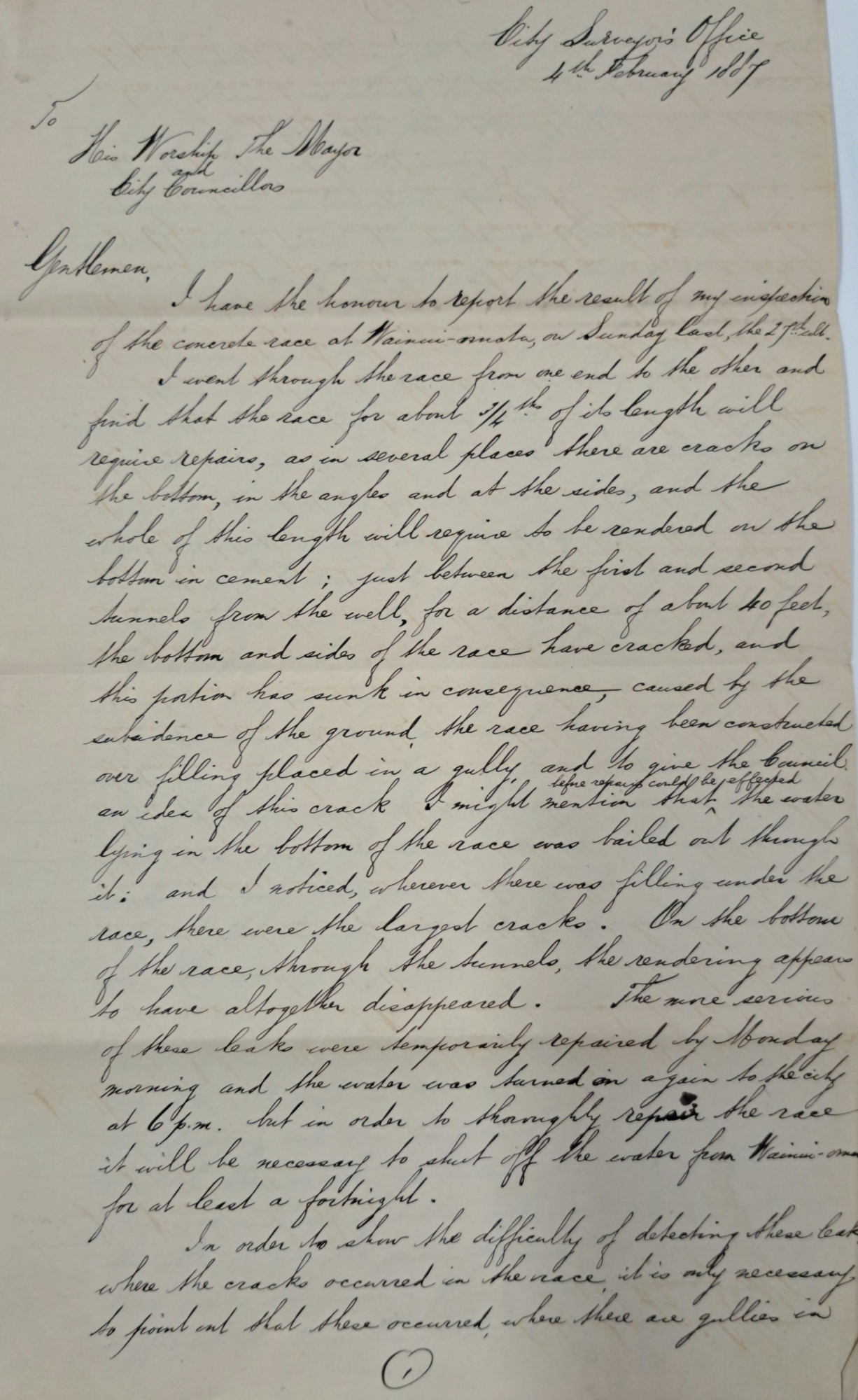
I have the honour to report the result of my inspection of the concrete race at Wainuiomata on Sunday last, the 2nd inst. I went through the race from one end to the other and find that the race for about ⅞ths of its length will require repairs, as in several places there are cracks on the bottom, in the angle and at the sides, and the whole of this length will require to be rendered on the bottom in cement.
Just between the first and second tunnels from the well, for a distance of about 40 feet, the bottom and sides of the race have cracked, and this portion has sunk in consequence caused by the subsidence of the ground, the race having been constructed over filling placed in a gully. To give the Council an idea of this crack I might mention that the water lying in the bottom of the race was bailed out through it, and I noticed, where there was filling under the race, there were the largest cracks.
At the bottom of the race, through the tunnels, the rendering appears to have altogether disappeared. The more serious of these leaks were temporarily repaired by Sunday morning and the water was turned on again on Sunday at 6 pm, but in order to thoroughly repair the race it will be necessary to shut off the water from Wainuiomata for at least a fortnight.
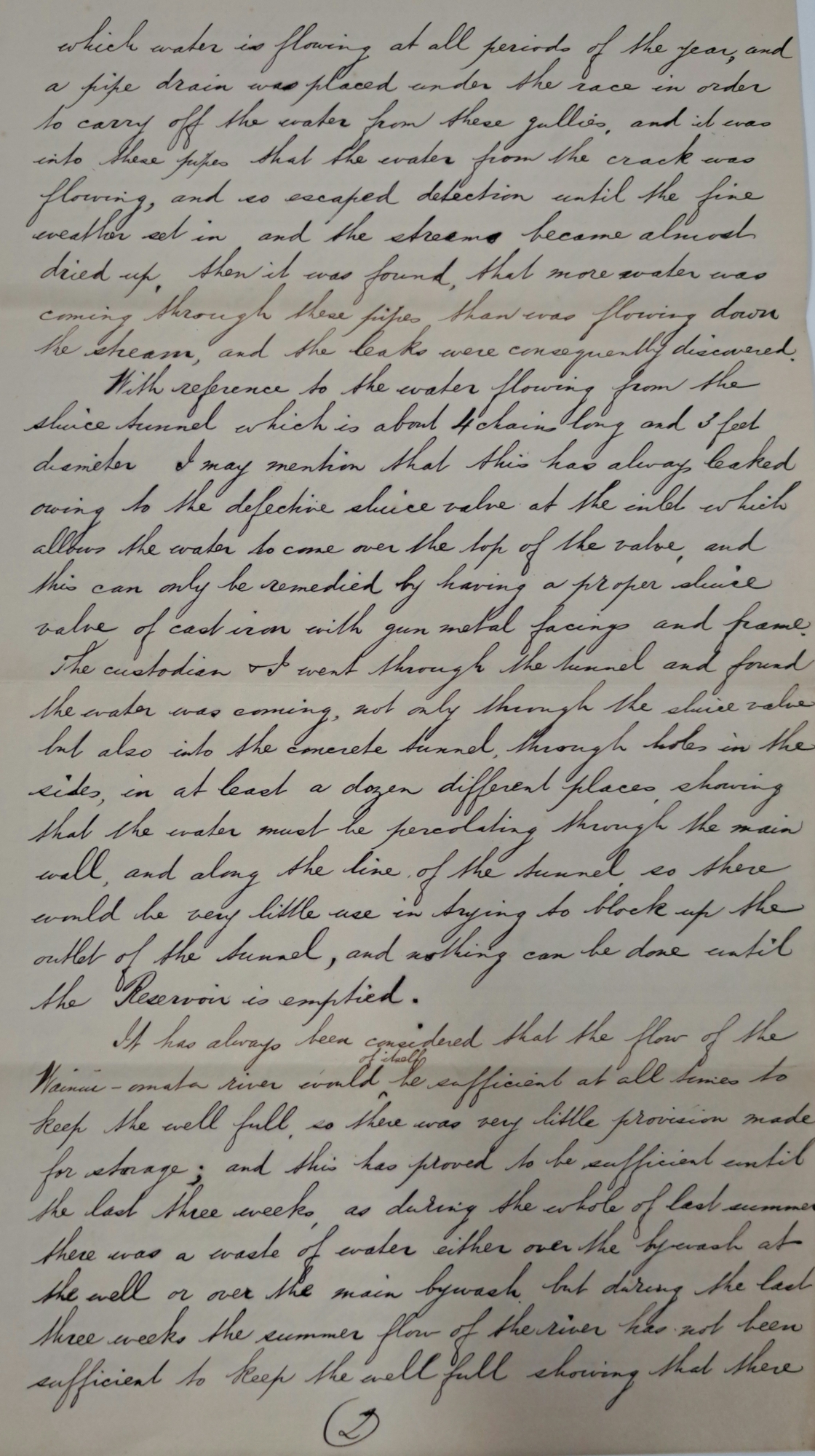
In order to show the difficulty of detecting these leaks where the cracks occurred in the race, it is only necessary to point out that these occurred where there are gullies in which water is flowing at all periods of the year, and a pipe drain was placed under the race in order to carry off the water from these gullies. It was into these pipes that the water from the crack was flowing, and so escaped detection until the fine weather set in and the stream became almost dried up. Then it was found that more water was coming through these pipes than was flowing down the stream, and the leaks were consequently discovered.
With reference to the water flowing from the sluice tunnel, which is about 40 chains long and 4 feet diameter, I may mention that this has always leaked owing to the defective sluice valve at the inlet which allows the water to come over the top of the valve, and this can only be remedied by having a proper sluice valve of cast iron with gun metal facing and frame.
The occasion I went through the tunnel I found the water was coming not only through the sluice valve but also into the concrete tunnel through holes in the sides in at least a dozen different places, showing that the water must be percolating through the main wall and along the line of the tunnel. So there would be very little use in trying to block up the outlet of the tunnel, and nothing can be done until the reservoir is emptied.
It has always been considered that the flow of the Wainuiomata river would be sufficient at all times to keep the well full, so there was very little provision made for storage. This has proved to be sufficient until the last three weeks, as during the whole of last summer there was a waste of water either over the bywash at the well or over the main bywash. But during the last three weeks the summer flow of the river has not been sufficient to keep the well full, showing that there is either a greater consumption in the city or that the summer flow this year is much less.
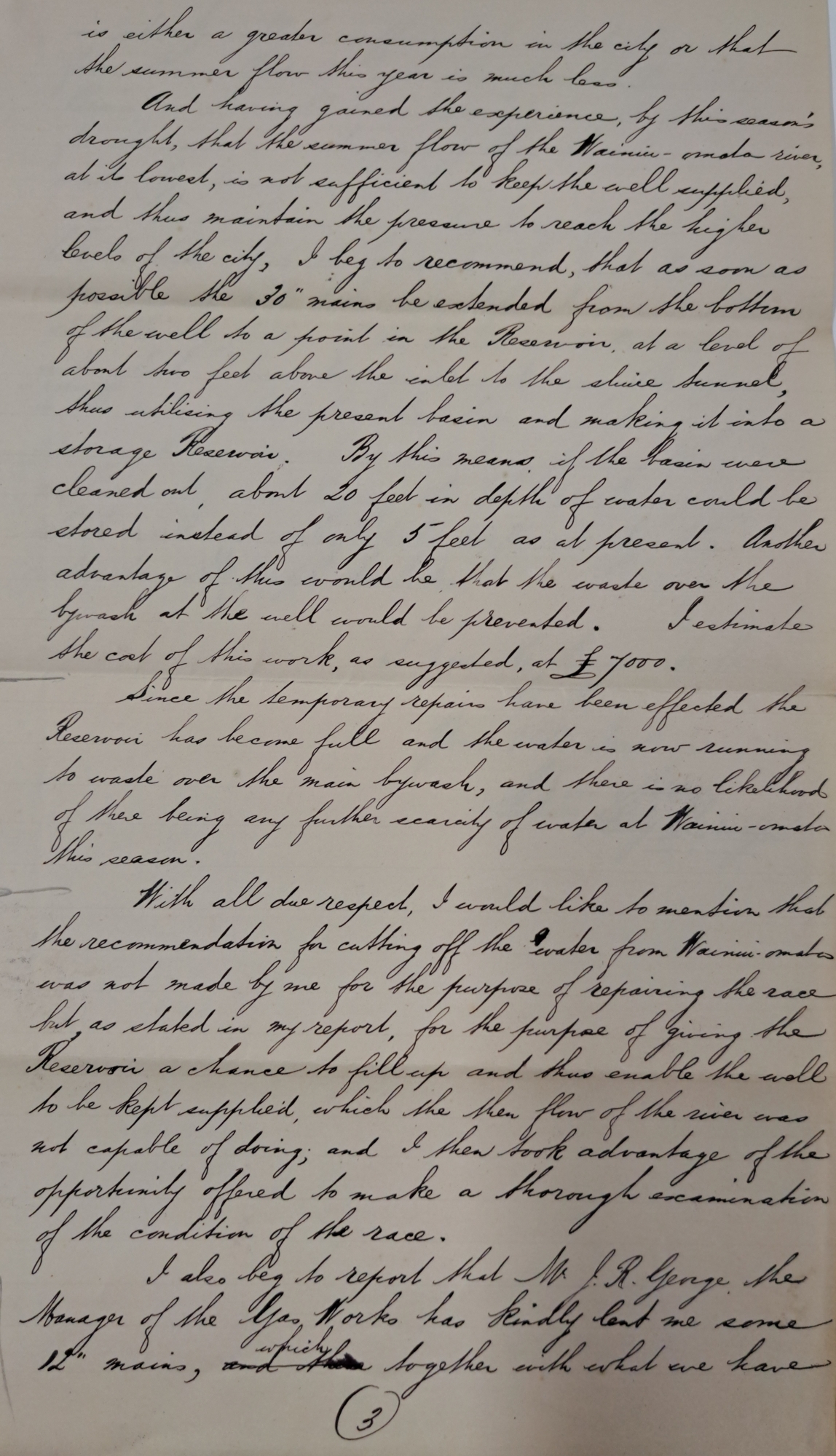
And having gained the experience of this season’s drought, that the summer flow of the Wainuiomata river at its lowest is not sufficient to keep the well supplied and thus maintain the pressure to reach the higher levels of the city, I beg to recommend that as soon as possible the 30 inch main be extended from the bottom of the well to a point in the present creek at a level of about two feet above the sill of the sluice, thereby utilising the present basin and making it into a storage reservoir.
By this means, if the basin were cleaned out, about 20 feet in depth of water could be stored instead of only 5 feet as at present. Another advantage of this would be that the waste over the bywash at the well would be prevented. I estimate the cost of this work, as suggested, at £7000.
Since the temporary repairs have been effected the reservoir has become full and the water is now running to waste over the main bywash, and there is no likelihood of there being any further scarcity of water at Wainuiomata this season.
With all due respect, I would like to mention that the recommendation for cutting off the water from Wainuiomata was not made by me for the purpose of repairing the race, but as stated in my report, for the purpose of giving the reservoir a chance to fill up and thus enable the well to be kept supplied, which the then flow of the river was not capable of doing. I then took advantage of the opportunity offered to make a thorough examination of the condition of the race.
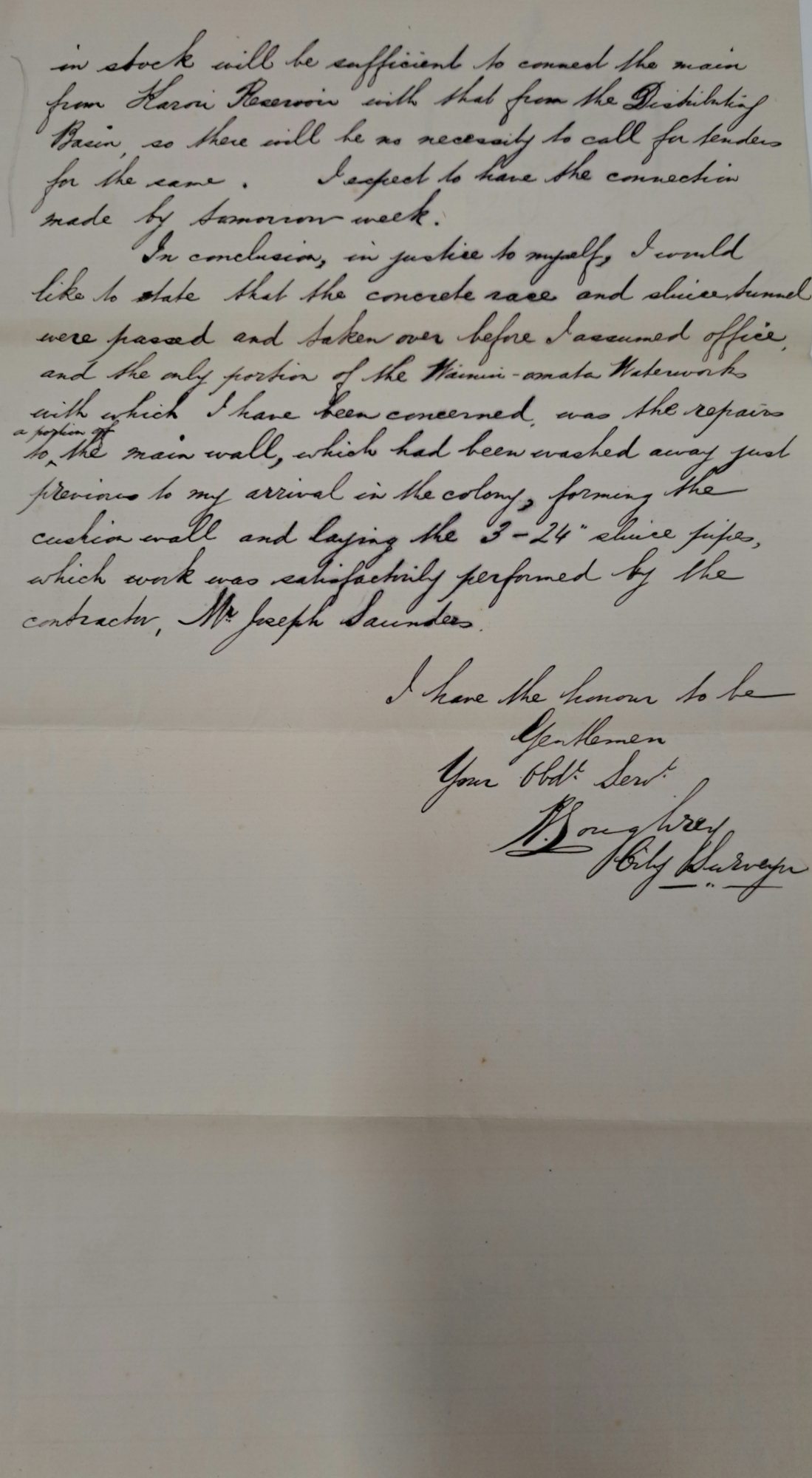
I also beg to report that Mr J R George, the Manager of the Gas Works, has kindly lent me some 12 inch mains, together with what we have in stock, which will be sufficient to connect the main from Hutt Reservoir with that from the Orongorongo stream, as there will be no necessity to call for tenders for the same. I expect to have the connection made by tomorrow week.
In conclusion, in justice to myself, I would like to state that the concrete race and sluice tunnel were passed and taken over before I assumed office, and the only portion of the Wainuiomata Waterworks with which I have been concerned was the repairs to the main wall which had been washed away just previous to my arrival in the colony, forming the section wall and laying the 12 and 24 inch sluice pipes, which work was satisfactorily performed by the contractor, Mr Joseph Saunders.
I have the honour to be
Gentlemen
Your Obdt. Servt.
Loughrey
City Surveyor
Source: Wellington City Council Archives, 00233-1887/243