
Wainuiomata has had at least four different catchment areas with two still current today.

Before Wainuiomata became part of Wellington’s water supply system, the city relied on springs, streams, wells, and rooftop collection. In the early years, these sources provided a surplus, but as the population grew, demand began to exceed supply.
To address this, a major water supply scheme was developed in the 1870s. It included the construction of a 35 million gallon storage reservoir at Karori, a tunnel approximately 1,200 feet long to Polhill Gully, a 500,000 gallon service reservoir, and around 13½ miles of distribution piping. This infrastructure was adequate for about a decade, but rising demand made it clear that an additional supply was needed.
The Wainuiomata River was identified as a suitable source as early as 1878, leading to the construction of an earth dam and waterworks. Not only was water sourced from Wainuiomata, but the water was even used to generate power to run street lamps for a time.
In 1904, a second dam was built at Karori to increase capacity. Then, in 1908, work began on the Morton Dam in Wainuiomata, which would provide further storage to meet the city’s growing needs.
As for Wainuiomata itself, the suburb was not initially supplied by the main Wainuiomata water scheme due to cost. Instead, Wainuiomata developed its own local sources to meet its water needs. These included small catchments such as the Hair Street Catchment and Skerretts Creek Catchment, which provided water specifically for the suburb’s use.
Wainuiomata / Orongorongo Water Supply Scheme
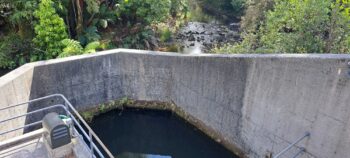 With two catchment areas, this scheme got its start from an 1878 fire at the Wellington’s railway station. The lack of water to deal with the problem led to a search for a new water source in the Wellington region. The Wainuiomata Valley, adjacent to the Hutt Valley was chosen as the site for the water catchment followed by construction of an earth dam (known today as the Lower Dam) in 1878. Upon completion, it supplemented Wellington’s water supply along with the already existing catchment at Karori in the hills behind Wellington city.
By 1900, the city council sought solutions to enhance the water supply as water shortages became common. A larger dam proposed for Wainuiomata was rejected initially, but eventually accepted in 1904 after earthquakes, floods, and drought hit Wellington. The dam was completed in 1911, along with a second pipeline to Karori in 1912.
Population growth continued, with the driest years on record from 1915-17 nearly emptying the city’s reservoirs. Similar conditions in 1919 led the council to explore the Orongorongo Valley as a second water catchment in this scheme. Work began in 1921 to build weirs on the Orongorongo River and a tunnel linking the valleys, and a pipeline to Karori reservoir.
Skerretts Creek Water Catchment
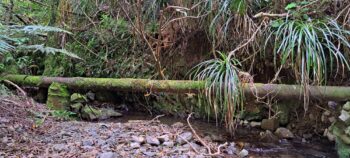 Skerretts Creek was Wainuiomata’s alternative to the Wellington Water supply from Morton Dam, operating briefly from the mid-1950s to the early 1960s. In the late 1950s, Hutt County Council took over the water supply, eventually connecting to the WCC pipeline for Morton Dam access. The Konini Reservoir’s creation later ensured a stable water source for Wainuiomata.
Hair Street Water Catchment (Wainuiomata Scenic Reserve)
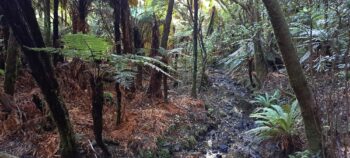 A water intake scheme was situated north of the Hair Street terminus. Built in the early 1940s, it discontinued operations by the early 1960s. No traces of the water intake scheme exist today. The area is now part of the Wainuiomata Scenic Reserve.




DISCUSSION