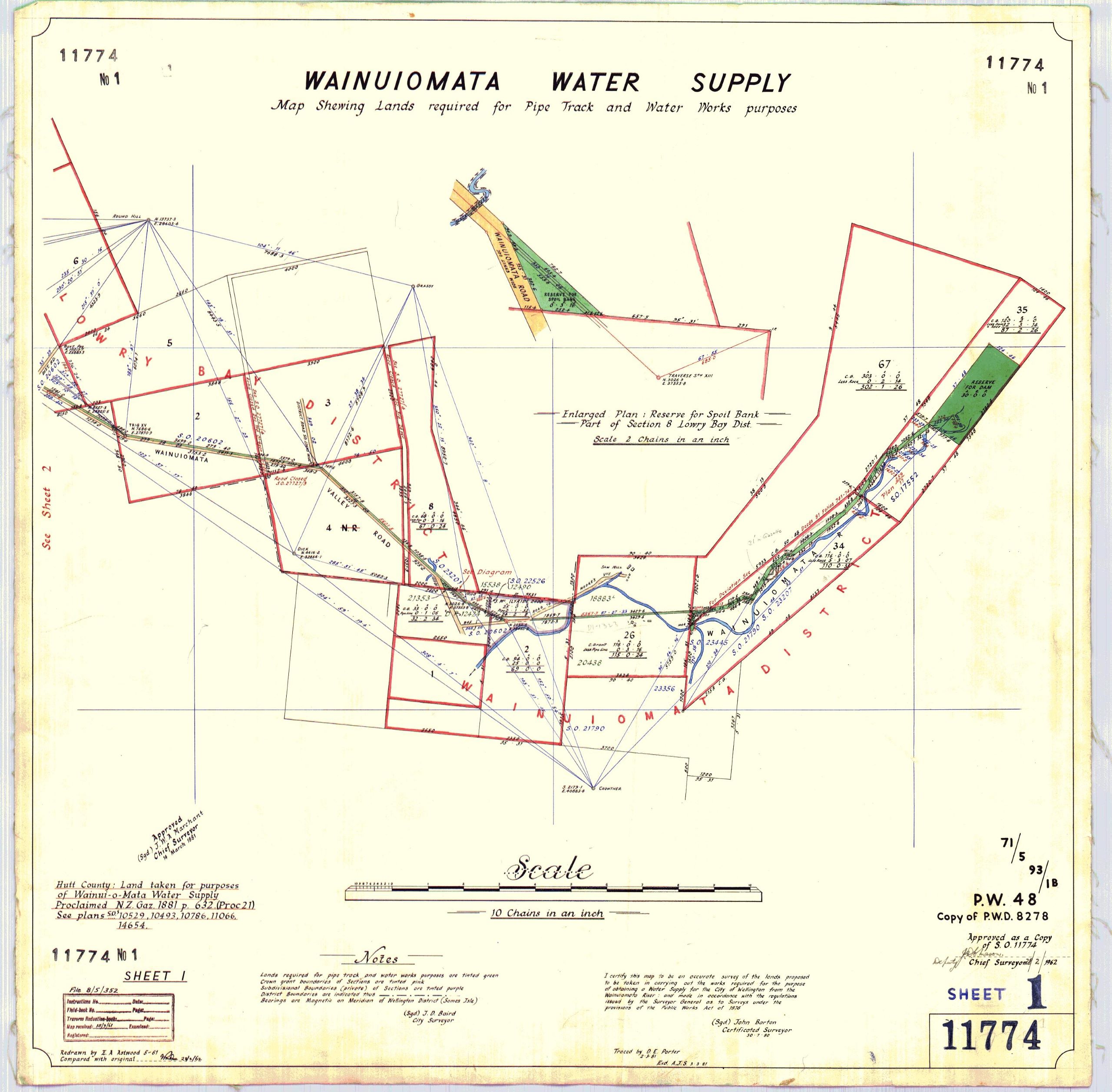
This 1881 plan shows the land proposed for acquisition for the development of the Wainuiomata water supply.
The area shaded in green marks the route of the pipe track, where the water race was to be constructed, along with other associated waterworks infrastructure and a designated reserve or catchment area. The main pipeline running through Wainuiomata is also shown on the plan.
Crown grant section boundaries are tinted pink, while private property boundaries are shown in purple. District boundaries are outlined with a dashed-and-dotted line.
The map was certified as accurate by John Barton in 1880 and traced by D.E. Porter on 2 March 1881. This is a certified copy made in 1962.
The 1881 plan outlines the proposed land to be acquired for the Wainuiomata water supply scheme. Several sections were identified for partial acquisition to enable the construction of waterworks infrastructure, including the dam, water race, and main pipeline:
- Section 35 was originally 120 acres, 3 roods, and 0 perches. Of this, 32 acres, 3 roods, and 14 perches were proposed for use in the construction of a dam and water race, leaving a balance of 87 acres, 2 roods, and 26 perches.
- Section 67 measured 303 acres, with 0 acres, 2 roods, and 14 perches (equivalent to about 0.5875 acres) proposed for the water race, leaving 302 acres, 1 rood, and 26 perches.
- A 30-acre reserve is marked out in green for the future construction and operation of a dam. This was typical in 19th-century New Zealand schemes, where additional land was set aside for catchment protection and operational space.
- Section 26 originally comprised 116 acres. The plan proposed 3 roods and 16 perches be used for the pipeline, reducing the remainder to 115 acres and 24 perches.
- Section 8 began with 68 acres. After the proposed deduction of 3 roods and 16 perches for the pipe track, 67 acres and 24 perches would remain.
- J. McIlvride’s holding was recorded as 25 acres. The plan indicates 1 rood and 32 perches (almost half an acre) would be used for the waterworks, leaving 24 acres, 2 roods, and 8 perches.
Note: New Zealand inherited the British imperial measurement system, where land was traditionally measured in Acres, Roods (¼ acre), & Perches (¹⁄₁₆₀ acre). These units appeared in Crown grants, survey plans, rates records, and titles throughout the colonial period. Metrication didn’t begin in NZ until the 1970s, so imperial units were universal in land records up to that point.
The water race and pipeline route on the plan are marked with sectional distances in feet along the outside of the green strip. Inside the strip, numbers appear that likely represent elevation in feet, not above sea level, but above a locally defined zero point used for design purposes. In the 19th century, surveyors often chose an arbitrary or convenient local reference point as their “datum” to simplify calculations, especially for gravity-fed systems.
In this plan, the zero point isn’t identified, but we can infer that it sits about 60 metres (approx 200 feet) above sea level. This is because the elevation values shown in feet align closely with modern sea-level elevations when converted, suggesting the numbers represent real elevation, just measured from a starting point around 60 metres up. While it’s common for the intake of a dam to serve as the base point, that doesn’t seem to be the case here, so the exact origin of the datum remains unknown at this point.
One theory for this zero point is the Wainuiomata River as it runs continuously through the valley, offering a reliable reference line with a naturally decreasing elevation, ideal for a gravity-fed system like a water race to follow. Using the riverbed (or a point along it) as “zero” would allow engineers to calculate gradients and fall over distance more easily.
Special thanks to Jeremy Foster for sourcing this document.