
Wellington City Council – Copyright License: CC-BY
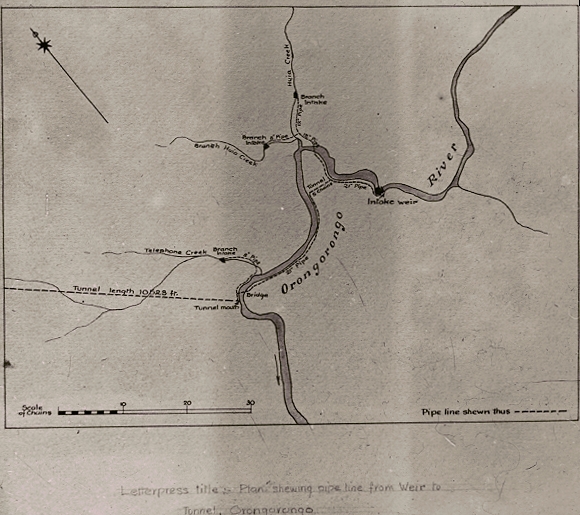
Map, showing the pipeline from the weir to the tunnel, in the Orongorongo Valley Water Catchment, c 1924.
This early map of the Ōrongorongo water-supply scheme shows the relationship between the Ōrongorongo River, Telephone Creek, the intake structures, pipeline and the entrance to the main water tunnel.
Among the clearest labels on the map are:
Rivers and creeks
- Orongorongo River
- Telephone Creek
- Huia Creek
Water-supply infrastructure
- Intake Weir
- Domestic Intake
- 21″ Pipe
- Pipe line shown thus
- Branch – this appears beside at least one pipeline or creek junction
- Bridge
Tunnel
- Tunnel Mouth
- Tunnel length 10,494 ft
The tunnel length shown on the map appears to be 10,494 feet, or approximately 3.2 kilometres.
Telephone Creek area
Several labels are clustered around the Telephone Creek section of the plan, including:
- Telephone Creek
- Branch
- Bridge
- Tunnel Mouth
There also appear to be additional small branch or pipeline annotations in this part of the map, although some of the handwriting is too faint to read with certainty.
Scale and orientation
The map includes a Scale of Chains, with markings appearing to show:
- 0
- 10
- 20
- 30 chains
A north or orientation arrow is also shown in the upper-left corner of the map.
Caption beneath the map
The printed caption beneath the map appears to read:
“Letterpress title:- Plan showing pipe line from Weir to tunnel. Orongorongo”
The map is particularly useful because it records the layout of the Ōrongorongo waterworks at an early stage, showing how the river, tributaries, intake structures, pipeline and tunnel were connected as part of Wellington’s expanding water-supply system.
Some of the smaller handwritten labels remain too faint to transcribe confidently, so these have been left unidentified rather than interpreted without sufficient evidence.




)