
Beginnings in a Settler Homestead (1857+)
Formal schooling in Wainuiomata began on 23 February 1857, when lessons were first held in the home of early settler Mr Prouse. At that time, education in rural districts often relied on improvised arrangements, and the valley was no exception.
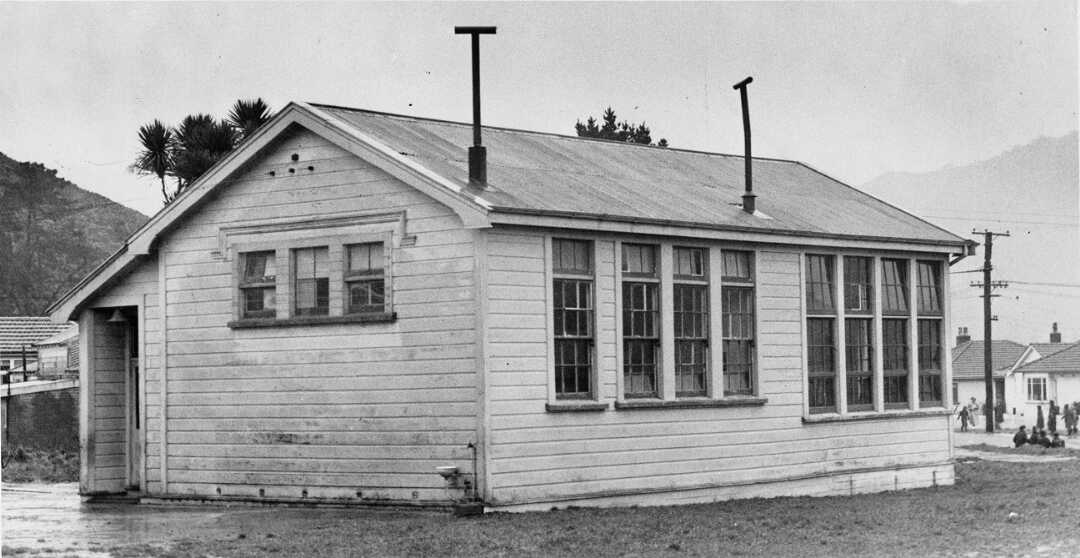
As the small farming community became more established, a purpose-built school replaced the original homestead classroom. This building would, in turn, be superseded in the early twentieth century by a more permanent structure, remembered today as the “Old School”. Its construction marked a shift from informal instruction to a more structured and enduring education system in the valley.
Post-war Expansion of Wainuiomata School (1948 to 1957)
A dramatic turning point came after World War II, when state housing development and population growth transformed Wainuiomata. The single school that had served the valley for decades was no longer sufficient.
New classrooms were added to the Old School and Wainuiomata School was born. By the 1970s, under principal Norm Wright (1971 to 1986), Wainuiomata School had grown to approximately:
- 22 classrooms
- 19 teaching staff
- Around 350 pupils
This represented a substantial increase from its early roll, illustrating how rapidly the valley had developed within a single generation.
The Emergence of New Schools (1958 to 1978)
As residential areas spread, entirely new schools were required to meet demand.
Glendale School (1958)
Located in Frederick Street, Glendale became the second primary school in the valley. Its growth was swift, with enrolment reaching approximately 1,195 students by 1965, making it one of the largest schools in the area at the time.
Fernlea School (1963)
Opened in Lee Grove, Fernlea served expanding neighbourhoods to the south and east, helping to relieve pressure on both Wainuiomata and Glendale.
Wood Hatton School (mid 1960s)
Established in Wood Street, this school took its name from the earlier Faulke family farm, reflecting the transition from rural land use to suburban development.
A Second Wave of Expansion (1965)
By the mid-1960s, demand once again outpaced capacity. Two additional schools were established:
Arakura School
Named by Ihaia Puketapu, with the meaning “Pathway to Knowledge”, this school reflected both cultural recognition and educational purpose.
Pencarrow School (Wise Street)
Positioned strategically between existing catchments, Pencarrow helped balance enrolments across the growing valley.
Growth into New Suburbs (Late 1960s to 1970s)
As development pushed further into previously undeveloped land, two more schools followed:
Parkway School (1969) – Konini Street
Sun Valley School (1978) – Meremere Street
These schools were closely tied to the expansion of state housing and new suburban subdivisions, marking the outer limits of major educational growth in Wainuiomata.
Leadership at Wainuiomata School
The original school remained a central institution throughout this period of expansion, guided by successive principals:
- Mr Prouse – first headmaster (1857), teaching from his home
- Norm Wright – principal from 1971 to 1986
- Adrian Olsen – principal from 1987 to May 1991
- Allison Burdon – current principal
Each tenure reflects a different phase in the school’s development, from frontier beginnings to a modern educational environment.



DISCUSSION