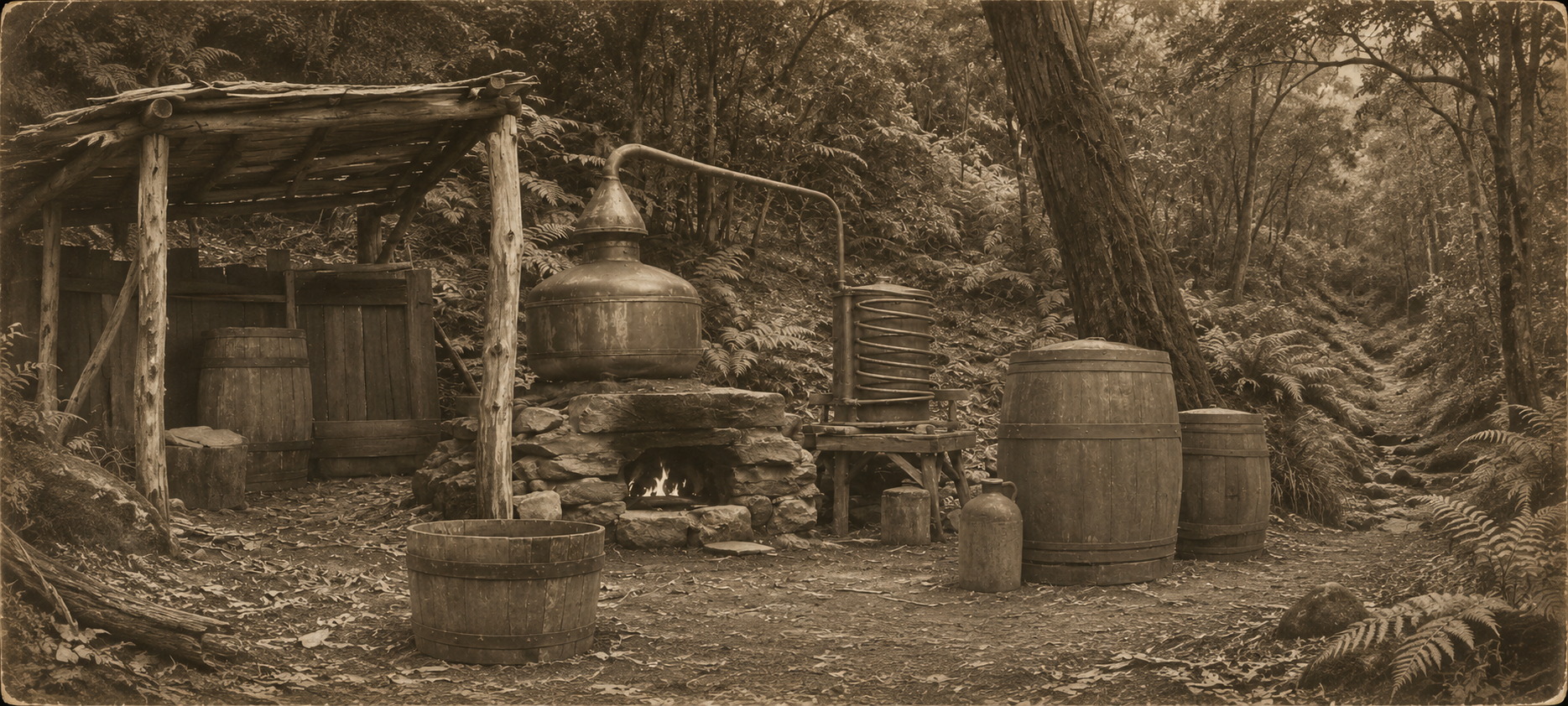
Generated image. This is not a photograph.
A hidden whisky distillery, a mysterious woodcutter who vanished into the bush, and four brothers accused of illegally producing spirits. These were the ingredients of an extraordinary case that unfolded in Gollans Valley, behind Wainuiomata and Eastbourne, in 1894.
On 13 June 1894, a party led by Collector of Customs Dugald McKellar and Acting-Detective James Gantley entered Gollans Valley searching for an illicit whisky still. Their investigation would eventually bring four members of the Cameron family, John, Allan, Charles and Hugh, before the Wellington Magistrate’s Court. John, Allan, Hugh and Charles Cameron were all brothers, the sons of John Cameron (1823–1888) and Catherine Caisey (1839–1899).
A mysterious disappearance in the bush
After searching several Cameron family homes without finding anything suspicious, Detective Gantley followed the sound of someone chopping wood deeper into the bush.
He came across a man felling a tree, accompanied by two dogs. However, when Gantley briefly turned to look for his companions, the man disappeared.
Left behind were an axe and a coat. Inside the coat were receipts and other documents bearing the names of Hugh and Charles Cameron.
Shortly afterwards, the search party discovered the illicit distillery. It contained equipment used for producing whisky, barrels of spirits, copper tubing, a fireplace and other materials associated with distillation.
Investigators also discovered approximately 100 kilograms of potatoes and a heap of mashed material believed to be barley or oats. Samples of liquid were subsequently examined by a government analyst, who identified alcohol at different stages of production.
A dray track led from near the Cameron family homes towards the still, with wheel marks suggesting recent use. A dray was a sturdy, usually two-wheeled cart pulled by a horse or bullock to transport heavy loads.
Whisky barrels and a reluctant witness
Among the evidence were barrels carrying the names of several established businesses, including Levin & Co., Black Diamond Brewery, Petone Brewery and Maginnity’s Blend.
The investigation also uncovered connections between the Cameron brothers and suppliers of sugar and other goods.
One of the most intriguing witnesses was Malachi Taylor, a brewer formerly associated with Black Diamond Brewery and Petone Brewery.
Taylor admitted visiting Gollans Valley on several occasions but became distinctly reluctant when questioned about what he had seen.
Asked whether he had encountered anything unusual in the valley, he replied:
“I must decline answering that.”
Even after being questioned privately by the magistrate, Taylor refused to say whether he had seen the still. The magistrate eventually ruled that he did not have to answer.
Four brothers face the court
The case came before Magistrate Martin on 7 July 1894, attracting detailed coverage in the New Zealand Times.
The Cameron brothers were represented by two lawyers, Thomas Wilford and Charles Skerrett. Skerrett, who later became Chief Justice of New Zealand, was a keen trout fisherman who regularly visited Wainuiomata during the 1880s and 1890s. Skerretts Creek was named after him. Interestingly, the lawyer prosecuting the case, Hugh Gully, had previously been Skerrett’s legal mentor.
Originally facing five counts, the brothers ultimately faced one proceeding concerning the unlawful manufacture of spirits after the prosecution abandoned the other four counts.
Charles Cameron denied knowing anything about the still when questioned by investigators.
The proceedings continued over several days, with witnesses giving evidence about tracks through the bush, deliveries of sugar and equipment, and possible connections to the distillery.
What happened to the Cameron brothers?
Despite the discovery of the distillery and the circumstantial evidence presented in court, proving who actually operated it was another matter.
According to a later history of the Cameron family published by Clan Cameron New Zealand, the charges against the four brothers were eventually dismissed because of insufficient evidence.
That family account also records an intriguing explanation for how the operation was discovered: a milk can reportedly fell over when a scow struck a wharf, spilling bottles of whisky and exposing the secret.
Whether every detail of that story can be independently verified remains uncertain, but the contemporary newspaper reports confirm that an illicit whisky distillery was discovered in Gollans Valley and that the ensuing investigation became a substantial court case.
More than 130 years later, the episode remains one of the more colourful chapters in the valley’s history, involving secret whisky production, an elusive woodcutter and a prosecution that struggled to establish who was responsible.
With Gollans Valley scheduled to open to the public by December 2026, this fascinating piece of local history provides another glimpse into the lives and activities of those who once occupied this remote landscape.