
Inside Cover
Be Prepared
LOOK SMART!
GET YOUR HAIR CUT AT
RAY SELIG LTD.
HAIRDRESSER & TOBACCONIST
For Ladies’ Hairdressing . . .
PERMING, CUTTING AND SETTING
RING 7074
RAY MUSTARD LTD.
Registered Master Builders
BUILDING CONTRACTORS & JOINERS
Alterations and Additions Quickly
and Neatly Executed
139 Main Road
WAINUIOMATA
Telephone 8516 P.O. Box 8
Under New Management
WAINUI SHINGLE CO.
G. J. INGLEY
SAND AND FINE AGGREGATES
BUILDERS’ MIX
(C.O.D.)
Orders—
W. HARGRAVES
98 Main Road, Wainuiomata
Phone 8642
Wainuiomata Fruit Supply
Moores Valley Road
FRESH FRUIT & VEGETABLES
—— Free Delivery ——
TELEPHONE 8669
FOR A TRIAL ORDER
Page 2
The Wainuiomata Scout
 VOL. I. No. 2.
SPRING, 1957.
The Official Organ of the
Wainuiomata Scout Committee.
Editor: Robert J. White.
Asst. Editor: A. W. Cawthorn.
Please address all correspondence
to the Editor, Wainuiomata Scout,
P.O. Box 10, Wainuiomata.
Telephone 7149 or 8736.
IN THIS ISSUE
| Page | |
|---|---|
| Message from the World Chief Scout | 1 |
| History of Wainuiomata Scout Group | 2 |
| Know your Wainuiomata | 4 |
| Young Athletes | 6 |
| Scouting and Antarctica | 7 |
| Letters to the Editor | 8 |
| Observation | 9 |
| The Editor Regrets | 10 |
| The Japanese Table Tennis Players | 11 |
| “Brookfield” | 12 |
| Troop Funds Running Out | 13 |
| Cubs’ Own Page | 14 |
| The Aqualung | 15 |
A Message from the World Chief Scout
The Boy Scouts Association,
Imperial Headquarters,
25 Buckingham Palace Rd.,
London, S.W.1.
Well done twice over. First of all, congratulations on the new H.Q. It’s taken a lot of hard work by a lot of busy people, and what a difference it makes to have a home of your own. Make good use of it and so give a real thank you to all your good friends.
Second, congratulations on a fine magazine. It’s made a good start that’s easy with a back log to work off, can you keep it up at this standard? That’s the real test. Remember the poor Editor will depend on all of you to keep him and his office desk full of material. It’s no use saying that’s his job. It’s yours.
All good wishes for good camping and good hunting.
ROWALLAN,
Chief Scout,
British Commonwealth and
Empire.
Lord Rowallan, K.T., K.B.E., M.C.
The Scout Promise
“On my honour I promise that I will do my best—
To do my duty to God, and the Queen.
To help other people at all times.
To obey the Scout Law.”
Page 2-3
History of Wainuiomata Scout Group
By J. L. DRYDEN
(Continued from the previous issue)
FIRST WAINUI TROOP
 Scouts from the Hutt Valley and Wellington came pouring into Wainui for their summer camps almost every week-end. They came on foot, on bicycles and in buses and occasionally the residents of the village could peep into the camp and see the little white tents dotted here and there or perhaps in the cool of the evening they could hear the voices of the boys singing round their camp fire and letting the heavens know that away from the city’s whirl and strife life is not so bad after all.
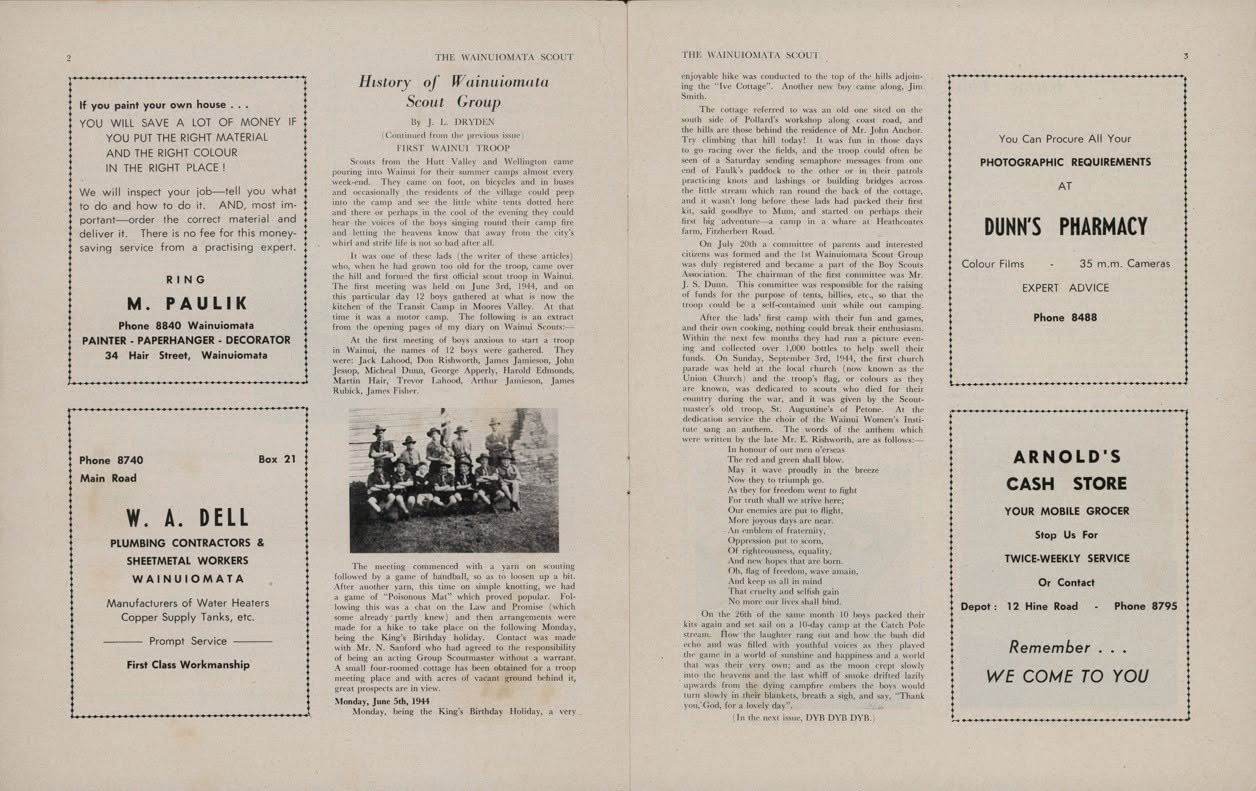
It was one of these lads (the writer of these articles) who, when he had grown too old for the troop, came over the hill and formed the first official scout troop in Wainui. The first meeting was held on June 3rd, 1944, and on this particular day 12 boys gathered at what is now the kitchen of the Transit Camp in Moores Valley. At that time it was a motor camp. The following is an extract from the opening pages of my diary on Wainui Scouts:—
At the first meeting of boys anxious to start a troop in Wainui, the names of 12 boys were gathered. They were: Jack Lahood, Don Rishworth, James Jamieson, John Jessop, Micheal Dunn, George Apperly, Harold Edmonds, Martin Half, Trevor Lahood, Arthur Jamieson, James Rubick, James Fisher.
The meeting commenced with a yarn on scouting followed by a game of handball, so as to loosen up a bit. After another yarn, this time on simple knotting, we had a game of “Poisonous Mat” which proved popular. Following this was a chat on the Law and Promise (which some already partly knew) and then arrangements were made for a hike to take place on the following Monday, being the King’s Birthday holiday. Contact was made with Mr. N. Sanford who had agreed to the responsibility of being an acting Group Scoutmaster without a warrant. A small four-roomed cottage has been obtained for a troop meeting place and with acres of vacant ground behind it, great prospects are in view.
Monday, June 5th, 1944
Monday, being the King’s Birthday Holiday, a very enjoyable hike was conducted to the top of the hills adjoining the “Ive Cottage”. Another new boy came along, Jim Smith.
The cottage referred to was an old one sited on the south side of Pollard’s workshop along coast road, and the hills are those behind the residence of Mr. John Anchor. Try climbing that hill today! It was fun in those days to go racing over the fields and the troop could often be seen of a Saturday sending semaphore messages from one end of Paulik’s paddock to the other or in their patrols practising knots and lashings or building bridges across the little stream which ran round the back of the cottage, and it wasn’t long before these lads had packed their first kit, said goodbye to Mum, and started on perhaps their first big adventure—a camp in a whare at Heathercote farm, Fitzherbert Road.
On July 20th a committee of parents and interested citizens was formed and the 1st Wainuiomata Scout Group was duly registered and became a part of the Boy Scouts Association. The chairman of the first committee was Mr. J. S. Dunn. This committee was responsible for the raising of funds for the purpose of tents, billies, etc., so that the troop could be a self-contained unit while out camping.
After the lads’ first camp with their fun and games, and their own cooking, nothing could break their enthusiasm. Within the next few months they had run a picture evening and collected over 1,000 bottles to help swell their funds. On Sunday, September 3rd, 1944, the first church parade was held at the local church (now known as the Union Church) and the troop’s flag, or colours as they are known, was dedicated to scouts who died for their country during the war, and it was given by the Scoutmaster’s old troop, St. Augustine’s of Petone. At the dedication service the choir of the Wainui Women’s Institute sang an anthem. The words of the anthem which were written by the late Mr. E. Rishworth, are as follows:—
In honour of our men o’erseas
The red and green shall blow.
May it wave proudly in the breeze
Now they to triumph go.
As they for freedom went to fight
For truth shall we strive here;
Our enemies are put to flight,
More joyous days are near.
An emblem of fraternity,
Oppression put to scorn,
Of righteousness, equality,
And new hopes that are born.
Oh, flag of freedom, wave amain,
And keep us all in mind
That cruelty and selfish gain
No more our lives shall bind.
On the 26th of the same month 10 boys packed their kits again and set sail on a 10-day camp at the Catch Pole stream. How the laughter rang out and how the bush did echo and was filled with youthful voices as they played the game in a world of sunshine and happiness and a world that was their very own; and as the moon crept slowly into the heavens and the last whiff of smoke drifted lazily upwards from the dying campfire embers the boys would turn slowly in their blankets, breath a sigh, and say, “Thank you, God, for a lovely day”.
(In the next issue, DYB DYB DYB).
Advertisements
M. PAULIK
If you paint your own house . . .
YOU WILL SAVE A LOT OF MONEY IF
YOU PUT THE RIGHT MATERIAL
AND THE RIGHT COLOUR
IN THE RIGHT PLACE!
We will inspect your job—tell you what to do and how to do it. AND, most important—order the correct material and deliver it. There is no fee for this money-saving service from a practising expert.
RING
M. PAULIK
Phone 8840 Wainuiomata
PAINTER – PAPERHANGER – DECORATOR
34 Hair Street, Wainuiomata
W. A. DELL
Phone 8740
Box 21
Main Road
W. A. DELL
PLUMBING CONTRACTORS &
SHEETMETAL WORKERS
WAINUIOMATA
Manufacturers of Water Heaters
Copper Supply Tanks, etc.
— Prompt Service —
First Class Workmanship
DUNN’S PHARMACY
You Can Procure All Your
PHOTOGRAPHIC REQUIREMENTS
AT
DUNN’S PHARMACY
Colour Films - 35 m.m. Cameras
EXPERT ADVICE
Phone 8488
ARNOLD’S CASH STORE
ARNOLD’S
CASH STORE
YOUR MOBILE GROCER
Stop Us For
TWICE-WEEKLY SERVICE
Or Contact
Depot: 12 Hine Road - Phone 8795
Remember . . .
WE COME TO YOU
Page 4-5
Know Your Wainuiomata
By A SETTLER
 In our last issue we recounted incidents that occurred in the lives of some of the early settlers in the valley, among whom the Prouse family featured rather prominently. In answer to our request for readers who were related, or knew of these families, we have been fortunate in having been approached by Mr. Claude Burdan, who was able to give us some very interesting anecdotes on the early days in the Valley, ably assisted by Mrs Burdan in the course of a very pleasant evening spent in their house.
It was interesting to learn that Richard Prouse, whom readers may remember was born whilst the family was sheltering in the calf house during an earthquake, was a true son of the hard adventurous stock from which he came, and while quite a young man, left the Valley to seek his fortune in Australia, and took part in the famous Bendigo gold rush. Although he apparently did not find much gold, he brought back something infinitely more precious, a wife, the same lady who was Mr. Burdan’s grandmother. As previously mentioned, the Prouse family were all very musical and formed a choir consisting entirely of members of the family. On one occasion they rendered the Messiah at a Church function in the Hutt.
Mr. Burdan is very proud of the fact that in 1910 he was a member of what was the first troop of scouts to be formed in the Valley. Their activities were based on Baden Powell’s book, “Scouting for Boys”, written only a short while before, and their meetings usually took place at the old school. The members of the early troop were: Leader, Bertie Burdan, Jack Wood, Claude Burdan, W. E. Prouse, Alf Williams.
These local pioneers of the movement had to cover several miles to their rendezvous; in some cases, the horse transport was generally employed as a means of getting there. It is pleasing to know that distance is still no obstacle to our boys today, several of whom ride several miles on their bicycles, among them being Bruce and Derek Cobb, nephews of Mr. Burdan, and still upholding the family traditions.
The roads in those days presented many problems and it was not unusual for a buggy to go up to its axles in potholes. Despite these difficulties, however, the local residents used to make regular trips once a week to the Hutt for shopping, most of which was done at Best’s or Feist’s stores, they being the only grocers. Feist’s was situated on the site of the old Lower Hutt library. The trip over from the Burdan home took one and a half hours. Strict rules governed the movement of traffic on the Hill Road. All up-traffic having the right of way, the principal passing points being known as Windy Point, Halfway Ridge and Green Gully. Mr. Burdan recalled how on one occasion, he was roundly berated by Dad Peters, a well-known character, who was carting a load of timber to Wainui on a six-horse dray and had stopped to give the horses a breather, because he went through without waiting for the team to pass him! The surface of the hill road was in those days fairly good and a credit to the pioneers who built it. Apparently the residents of the Valley asked the Government for a road and were told that if they wanted one they would have to build it themselves as there was no money or labour available for the job. The hill was split into sections which, considering the equipment they probably had to work with, must have been a monumental task, when one thinks of the struggle which is now ensuing to improve it.
The first car to enter the Valley was a two-cylinder Wolseley, driven by Sir Thomas Wilford, whose father was one of the early doctors in the Hutt.
Mr. Burdan recalls how in his younger days he received his initial instruction in music from Miss Crowther. She remembers Northbrook, the old house at the junction of Moore’s Valley Road and the Reservoir Road, in its heyday. Northbrook was built by a retired sea captain, one Captain Mowlem, who is buried in the Wainui Cemetery.
He recalls an early tragedy in 1870 when the school master, a Mr. John Clarke, whilst searching for his cow which had got out of the paddock on a cold southerly day, got lost in the bush, and despite the efforts of search parties, scouring the area, was not found for three days. His body was located over the ridge near the Catchpole Stream, approximately four miles from home, Mr. Clarke having died from exposure.
Mr. Burdan, who is still actively farming 700 acres in the Valley, remembers the days when gorse was an unknown plant in this locality, and wryly comments that it was originally introduced for use as wind breaks and hedges at 1/6 per plant. Apparently the Wainui gorse was imported from Ireland, which may account for its indomitable character.
Unfortunately space does not permit us to record the many anecdotes related by Mr. and Mrs. Burdan, but we should like to take the opportunity of thanking them for their contributions to our pages which we feel sure will be appreciated by our readers.
Photograph captions
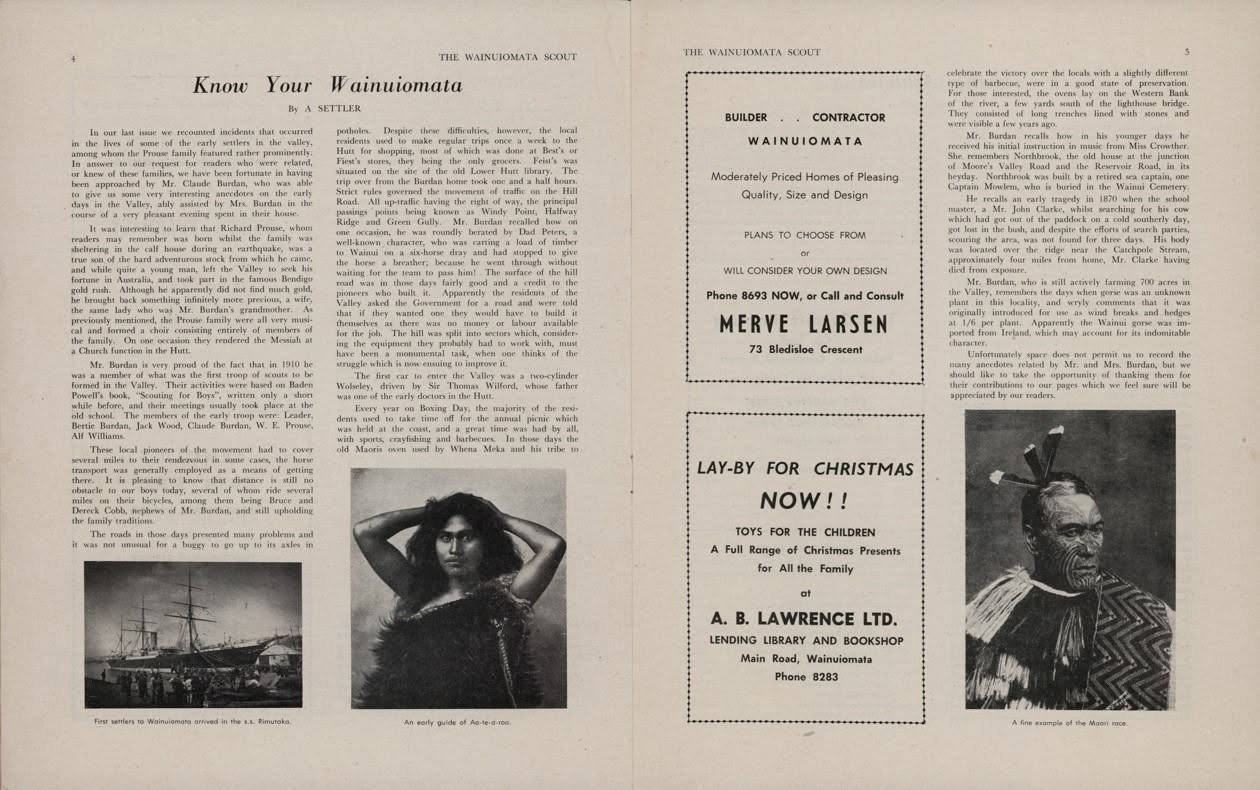
First settlers to Wainuiomata arrived in the s.s. Rimutaka.
An early guide of Ao-te-a-roa.
A fine example of the Maori race.
Advertisements
MERVE LARSEN
BUILDER . . CONTRACTOR
WAINUIOMATA
Moderately Priced Homes of Pleasing
Quality, Size and Design
PLANS TO CHOOSE FROM
or
WILL CONSIDER YOUR OWN DESIGN
Phone 8693 NOW, or Call and Consult
MERVE LARSEN
73 Bledisloe Crescent
LAY-BY FOR CHRISTMAS NOW!!
TOYS FOR THE CHILDREN
A Full Range of Christmas Presents
for All the Family
at
A. B. LAWRENCE LTD.
LENDING LIBRARY AND BOOKSHOP
Main Road, Wainuiomata
Phone 8283
Page 6-7
Young Athletes
By MAX CARR
 When Michael O’Callaghan won the Lane Cup, premier Trophy of the Wainui-o-Mata Amateur Athletic Club, he proved that he had many of the qualities which go to make an Olympic champion; speed, versatility, enthusiasm, determination, and the will to win. Other qualities; strength, endurance and perfection in athletic skills, are not normally found or expected in young children, but are developed during the teen ages.
Athletics is one of the few sports which caters for all of these qualities with special events for ability in many different ways. Real speedsters have the sprints, and those with endurance have the long distance events. The bouncy kangaroo types can take to jumping events, the agile gymnasts to pole vaulting or javelin throwing, while the bulky or ponderous but usually stronger types can forge ahead in weight events such as discus, shot and hammer.
Speed, strength, endurance, spring and agility, none is sufficient alone. All are essential in some degree in each event and must be developed and co-ordinated to produce the best performance. The personal qualities, enthusiasm, determination and the will to win added to fully developed natural ability and correct technique make up the successful athlete and by the successful athlete I mean the one who always competes to the best of his or her ability, enjoys the event and makes the competition enjoyable for other competitors, spectators and officials. Athletics is a game and should be enjoyed both in training and in competition, otherwise why take part? When interest and pleasure is lost and it becomes a drudgery it is time to change to something else. This is perhaps the greatest concern of the coaches and administrators of the Athletic Club.
Most of our club members are primary school children who come along to take part in a game which they enjoy. Specialised coaching is kept to a minimum. Suitable events are provided and the basic athletic skills are taught. Most emphasis is placed on enthusiasm, sportsmanship and the ability to lose and win gracefully.
As these young athletes are not permitted to race over long distances, training is unnecessary. The average child does more than enough scampering about during the day to keep fit. They also do so much running about on athletic evenings that warming up is not really necessary. Each evening is started with a few simple exercises to establish wise habits and to give variety. For the same reason and to make sure every one keeps warm a little easy jogging is introduced when the evening is cold.
Now to get back to this coaching business. More champions are marred than made during an athlete’s early years through the over enthusiasm of parents, the often well meaning efforts of unknowledgeable coaches, and most commonly the eagerness of the young athlete who trains and trains alone trying always to get better results until he is tired out physically and mentally and becomes stale. Staleness is a state of mind brought about by boredom when a sport no longer holds interest and there is no enjoyment, no will to win.
I have mentioned the will to win several times and may be taken to task by those who say, “It is the game that matters. Winning is of secondary importance”. What they say is true but a game is not worth playing if you don’t try to win. There is no pleasure in winning if the opponents are not trying.
In the Athletic Club, we aim to build up a strong group of young athletes, some of whom will develop into champions, but all of whom will enjoy playing well at a fine sport. They will be encouraged to conduct themselves, win or lose, in a way that will reflect credit on the club and the district.
The Garratt Printing Co. Ltd.
Publication, Commercial Printers
and Advertising Contractors
9-15 HAINING STREET
P.O. Box 6402, Te Aro
WELLINGTON
Telephone 52-050
ACKNOWLEDGEMENTS
This magazine could not be possible without the support of advertisers, and undermentioned business people of Wainuiomata:
Harry Keene, Builder
Lees Footwear and Clothing
Trimstyles, The Gown Shop
Wainui Service Station
R. C. Miles, Land Agent
K. R. Greig, Ltd., Building Contractors
N. V. Payne, Electrician
I. H. Whitcher, Estate Agent
A. T. Thompson, Electrician
Bradbury’s Fish Supply
Valley Milk Supply
Star Stores (N.I.) Ltd.
L. Murphy, Builders
Scouting and Antarctica
By A. S. HELM, M.A., F.R.G.S., Secretary, Ross Sea Committee.
Apart from the adventure angle of exploration, there are definite links going back for over thirty years between the scouting movement and Antarctica.
That great British explorer, Sir Ernest Shackleton, was the first Antarctic leader to pay tribute to the principles underlying the scouting movement.
When Shackleton was organising the expedition on which he was to lose his life, it was felt that there was need for a good boy in the party. Sir Ernest decided that he would throw the post open to a Boy Scout, and the suggestion was taken up with the greatest enthusiasm by the Boy Scout organisation. When the vacancy—open to Boy Scouts only—appeared in the “Daily Mail” a flood of applicants poured in from all parts of Great Britain. The ten most suitable boys were invited to London for interviews. These ten boys all had excellent records and Sir Ernest, in making his decision, found it so difficult to decide that he ultimately chose two. They were J. W. S. Marr from Aberdeen, and a boy from the Orkney Islands. Although the Orkneys are storm-swept, the latter suffered so severely from sea-sickness that Shackleton reluctantly had to send him back from Madeira, for he feared the effects of the huge seas which circle the world without interruption far to the south of the temperate zones.
Marr proved an excellent choice and was later to become famous in his own right as an Antarctic explorer. He served with Mawson in the British, Australian, New Zealand Antarctic Research Expedition as an expert in modern hydrological and plankton research. In 1944 he was chosen as leader of the British Expedition to the Falkland Islands Dependencies, which even in wartime carried out valuable scientific and survey work in this inhospitable area fringing the Antarctic Continent to the south of South America.
When Admiral Byrd was planning his first Antarctic Expedition he recalled Shackleton’s plan of taking a Boy Scout and decided to do likewise. He had no dearth of choice, and out of the 60,000 applicants he finally selected a twenty-year-old Eagle Scout named Paul Siple. Paul was in Wellington recently, as Admiral Byrd’s right-hand man. I noticed that whenever the Admiral wanted to confirm anything, he always turned to Paul and said with his slow drawl, “What would you say to that, Paul?” There was good reason for seeking his advice, too, for Paul—now Dr. Siple—has accompanied the Admiral on every one of his Antarctic trips, and is a world authority on Antarctica.
While the New Zealand party, unfortunately cannot take a Boy Scout as such—we aim at a higher age group for expedition personnel—you can be sure that there will be plenty who have been Boy Scouts in the team chosen, for the spirit of adventure which is associated with scouting, is, of course, also closely linked with the desire of every expedition member to add more knowledge to the little known about Antarctica.
Yet, though Boy Scouts cannot personally accompany the men to the south, they can be of utmost value in seeing that this New Zealand party is the best equipped and trained of any to go to the Antarctic Continent.
This takes a great deal of money, and we hope that the Boy Scout movement will do its share in ensuring that our men lack for nothing.
These men have a dangerous, and in some ways an unenviable task, but there were hundreds of volunteers to accompany Sir Edmund Hillary. Over the past year I have had a great deal to do with Sir Edmund, and I have come to admire his sterling qualities in many fields. There is no doubt that he is a great leader, and we will have a splendid team to assist him.
This has been said to be the last and greatest adventure facing mankind. There will be many, many more great adventures of course, as long as mankind has anything left to explore, but it will be a great thing to be able to say in years to come that we have had some part, however small, in assisting this splendid adventure to a successful conclusion.
I commend this thought to you.
GET WELL SOON
The Scouts, Cubs and friends of Miss Crowther wish her a speedy recovery from her illness and a quick return to Wainuiomata and Brookfield.
Advertisement
“A FENCE DOES TO A GARDEN WHAT
A FRAME DOES TO A PICTURE”
Garden Fences in
Tanalised Timber
precut in 6ft. lengths
THREE TYPES TO CHOOSE FROM
Inspection Invited
PRICES FROM 34/- PER 6ft. RUN
R. J. WHITE
Telephone 7149, Wainuiomata
Pages 8-9
Letters to the Editor
Office of Minister of Education
 Wellington,
10th June, 1957.
The Editor,
Wainuiomata Scout,
Reading Street, Wainuiomata.
Dear Sir,
I wish to acknowledge your letter of the 6th June enclosing a copy of your magazine, “Wainuiomata Scout”.
I would like to thank you for your courtesy in sending me this magazine and to express my admiration of the effort you have made to set up a publication containing items of interest and of educational value. The layout of the magazine is excellent, and I find that many of the articles attain a particularly high standard.
R. M. ALGIE,
Minister of Education.
Prime Minister’s Office
Wellington,
7 June, 1957.
Dear Sir,
I am writing on behalf of the Prime Minister, who is at present absent from his office because of an indisposition, to acknowledge receipt of your letter of 6 June with which you were good enough to enclose a copy of the first issue of the “Wainuiomata Scout”.
I know that Mr. Holland will very much appreciate your kind thought in making the magazine available to him and that he would wish me to convey his thanks to you together with his best wishes for the continued success of your activities.
Yours faithfully,
E. H. HALSTEAD,
Minister Assisting the Prime Minister.
20 Churton Crescent,
Taita.
7th June, 1957.
The Editor,
“Wainuiomata Scout”,
Reading Street, Wainuiomata.
Dear Sir,
I have perused with interest the first issue of your Group magazine and I would like to compliment you, as Editor, on the excellent standard which has been attained.
I trust that future editions of this publication will enjoy the support of the Wainuiomata Scouts and lay people which it undoubtedly deserves.
With best wishes for the future.
Yours faithfully,
Executive Secretary,
Boy Scouts Association of New Zealand.
Main Road North,
Wainuiomata.
7/6/57.
Editor,
“Wainuiomata Scout”.
Dear Sir,
Have just read the first edition of the “Wainuiomata Scout” and would like to congratulate you on a fine magazine. I wish you every success in future editions, and look forward to a monthly copy.
Yours in haste,
PETER WRIGHT.
264 Muritai Road,
Eastbourne.
7/6/57.
Dear Sir,
Having read your excellent Scout Magazine, I feel I must congratulate you on this first issue and hope you continue the good work with further issues.
I think the movement is of such importance as to need a medium such as this magazine to keep its members in touch with everything, and for outsiders to be able also to know what is news with the Scouts.
Yours faithfully,
E. MORRIS.
7th June.
Dear Editor,
Congratulations on a fine magazine.
I thought I would let you know I found your “Wainuiomata Scout” most enjoyable. It certainly is a credit to you.
This is the type of book everyone finds interesting.
My fellow workers join with me in wishing your magazine the best of luck, and look forward to seeing the next issue.
Yours sincerely,
A. MATTHEW.
114 Austin Street,
Wellington.
June 7th, 1957.
Dear Sir,
I was very interested in your June issue of the “Wainuiomata Scout”. A very good publication, containing many helpful hints and advice to the young lads who are Scouts, and those who have hopes of becoming one. Also many interesting articles for the elder Valley folks.
I am sure the troop will expand rapidly with such good workers behind them, and I wish the magazine all the luck for the future, and may you all become Queen’s Scouts.
Yours sincerely,
M. J. BARR.
Advertisements
IBELL’S STORE
MAIN ROAD – WAINUIOMATA
Telephone 8387
YOUR FOUR-SQUARE GROCER
FROZEN FOODS
GEAR PACK MEAT
Stop Before You Start
AT
TOP HAT MILK BAR
(Proprietor: R. A. Roulston)
MAIN ROAD, WAINUIOMATA
For . . .
CONFECTIONERY – ICE CREAM
Teas – Snacks & Luncheon in Congenial,
Comfortable Surroundings.
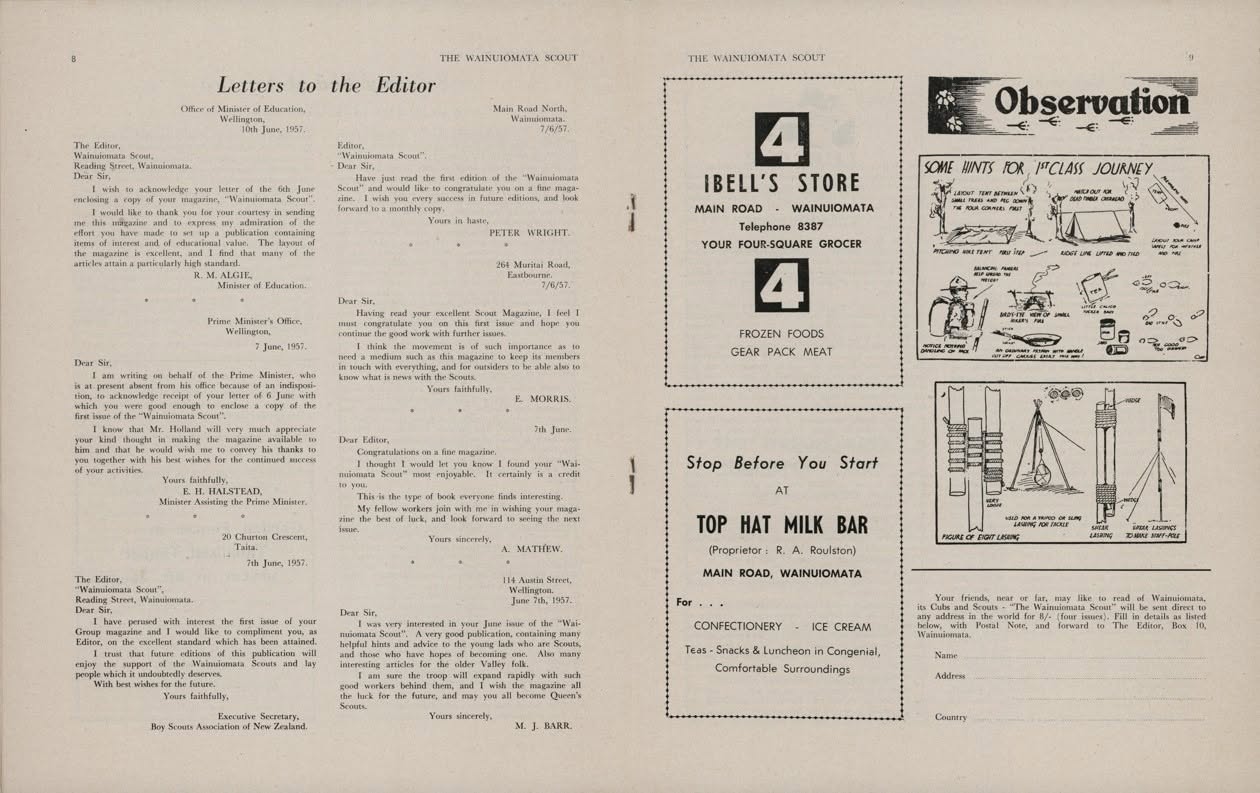
Observation
SOME HINTS FOR 1st CLASS JOURNEY
- LAYOUT TENT BETWEEN SMALL TREES AND PEG DOWN THE FOUR CORNERS FIRST
- PITCHING HIKE TENT — NEXT STEP
- PEG OUT THE TWO FRONT CORNERS
- RIDGE LINE LIFTED AND TIED
- BALANCE PACKS AND WATCH THE WEIGHT
- FIGURE OF EIGHT LASHING
- SQUARE LASHING
- SHEER LASHING TO MAKE SHEER-LEGS
Your friends, near or far, may like to read of Wainuiomata, its Cubs and Scouts – “The Wainuiomata Scout” will be sent direct to any address in the world for 8/- (four issues). Fill in details as listed below, with Postal Note, and forward to The Editor, Box 10, Wainuiomata.
Name ……………………………………………………
Address …………………………………………………
………………………………………………………………
Country …………………………………………………
Pages 10-11
The Editor Regrets . . .
 Patrol Leader Ginger came to my house the other day with his Cuckoo Patrol while Bill Cawthorn and I were hard at work preparing copy for this issue. He was wearing a battered compositor’s eyeshade and a battery of pens and pencils in each pocket. He said there would not be time for us to write any more articles like the “Chinese Wheelbarrow” which had made him look so ridiculous that the 1st Wainuiomata Troop would most surely suffer, and the S.M. had now appointed him Editor in Chief.
Ginger said that he would have to give the Wainuiomata Scout Magazine his careful consideration as he had some important schemes of his own to incorporate. He said he had never read more than thirty comics a week until Volume 1, No. 1 of the Wainuiomata Scout Magazine was issued last July. He was pleased he had read the magazine because he now knew how easy it was to produce. Ginger recognised the importance of our own publication and said it was just what our group needed. But it needed his personal supervision.
Skinny Taylor agreed with Ginger, and said the present editors were wasting their time and far too much money and black coffee, and as Bill and I had not included any pictures of Film Stars and Murderers, or blonde G.G.s, we could leave this issue entirely in their hands. But we could watch the patrol do the work as we might be useful people to have around when they wanted pencils sharpened.
Ginger said it would be better if we gave him 13/6 to buy the materials needed, and we could transfer the Editorial Offices from Reading Street to the Woodshed at the bottom of his garden. This was essential to cut costs, and we wouldn’t have to pay Mrs. White for making black coffee or Nigger Boy cocoa. We were to meet him in an hour with two items of news on murders or Marilyn Munroe, and all the old wallpaper we could find.
When we crowded into Ginger’s wood shed an hour later, we found him already practising on a very rusty old typewriter he had found in his uncle’s coal shed. He said it wouldn’t go at first but it was all right now as he had given it plenty of oil. The smell of cod liver oil had not improved the atmosphere of the wood shed. He let us all try the machine but he said we would have to choose our words carefully, because the “L” and the “R” had a way of sticking and the “P” was missing altogether.
Ginger made us cut up the wallpaper to fit the roller, he said he would go on typing until it was time for publication and then tear off a strip.
Bob and Martin were set to do some illustration while Skinny wrote a poem on “Spring”, and the rest of us went out in search of more news, or did research work in the dictionary.
At first Ginger said we must wait for some big news to break, but we soon got tired of that and decided to publish right away. Ginger had put little dashes in place of the missing “P”s, but just to make sure he typed a notice across the bottom:
“- lease – ut – s where a – – ro – riate”
The first number caused Quite a sensation and the S.M., Murray Randall, sent for Ginger. He said he was trying to admire the Possums’ latest activities, but he could not stand the smell of cod liver oil any longer. He said if Ginger was trying to stake a claim for a Scribe’s Badge, he must remember that although P.O.R. did not actually say so, it was intended that everything written should also be readable.
S.M. Murray Randall gave Ginger a packet of paper and a bottle of purple ink, and suggested that the Cuckoo Patrol should content itself with writing just one article for the Wainuiomata Scout and leave the rest to the Editor. He thought this would give the Cuckoo Patrol time to learn to spell a bit.
Ginger was a bit put out at first, and talked about dropping journalism and giving us a course in star-gazing, but when he read the directions on the bottle, he changed his mind. It was a special ink, and the directions said that if a copy was pressed on to a jelly as many as forty copies could be made from it. No more single copy publications. The idea fired Ginger, he said he thought it was the circulation that had got into his blood, he worked it out that if we included little bits about the Women’s Institute and the Girl Guides, we might be able to sell all forty copies at 6d. each and make a profit.
Skinny Taylor complained of writer’s cramp already, so Ginger copied the name of the special jelly, and sent him off to Dunn’s the Chemist to see if they sold it, while we laid plans for the Spring number.
The printing was not a great success, Ginger took pains, but he said that he had an idea something would go wrong as soon as Skinny said they were out of stock of the “Graph” jelly, but he had been to Ibell’s and bought two “Raspberries”.
The purple ink sank in alright, but when we pulled off the printed sheets, large pieces of jelly came up with them; it was while Ginger was trying to remove the jelly without wasting it that he got “Price 6d. monthly” tattooed on his tongue.
The few copies that we did get out made very sweet reading, but Ginger thought we might have difficulty in selling front pages only.
Ginger said it would be a pity to waste all the snappy little items we had collected together, so he is going to invent a pen which will write five copies at a time, and then we can concentrate on getting out our Christmas number. In the meantime, Ginger says we cannot afford to lose our capital, so he is going to let the purple ink soak into the jelly a bit more, and then sell it at the next troop camp fire as blackcurrant.
While Ginger concentrates on the jelly, he said Bill and I could get on with the Spring issue unaided by the Cuckoo Patrol, as he felt the June number could not have been too bad anyway as over 1200 magazines had been sold.
S. D. HILL
2 Moores Valley Road
WAINUIOMATA
WATCHMAKERS – JEWELLERS
ENGRAVERS
Telephone 7148
THE WAINUIOMATA TRANSPORT LTD.
GENERAL CARRIERS
Phones:
Wainui 8421 – Lr. Hutt Depot 60-766
Office at The Wainui Service Station
Suppliers of . . .
BUILDERS’ MIX – CEMENT
Sand – Metal Chips – Field Tiles
Drain Pipes – Polite
GENERAL BUILDERS’ REQUIREMENTS
The Japanese Table Tennis Players
By MURRAY DUNN
In 1954 a record gathering of thirty-five nations contested the team and individual titles at the 21st World Table Tennis Championships at Wembley’s Empire Pool, London. The Japanese won the Swaythling and Corbillon Cups and the Men’s Singles, and provided losing finalists in the Women’s Singles, and Mixed Doubles, and semi-finalists in the Women’s Doubles.
Prior to 1952 Japan had never played in international competition. It was not known how good they were, nor what style of game they played. All that was known was that table tennis was their national sport. However, in 1952, they entered a team in the World Championships, held that year in Bombay. They won four of the seven available titles; their success was immediately attributed to their use of bats faced with sponge rubber. It was thought that the other competitors would not be put off balance again by these pint-sized Oriental “shovel-bat” wielders.
They did not compete in World Competition again until 1954. Once again they proved their supremacy by winning all the major titles and once again a reason was sought for their success. Theories were advanced on how they could be beaten. A Welsh competitor claimed that they were vulnerable if one used a plain wooden bat against them. He suffered defeat at the hands of Ogimura in one of the shortest matches I have ever seen! Another player, an Englishman this time, told me how he was going to win his match against Tomita the following day. He spent most of his game picking up balls which had been hit past him by the ferocious Jap.
Only one thing was preventing these players, and many more like them, from beating the Japanese—they were not as good as their agile opponents. But surprisingly enough, many refused to be convinced. “It must be the sponge,” they said. At the World Table Tennis Congress there was a move to ban sponge bats. The Japanese delegate said that it would not affect their players if it was banned, for they would win using any kind of bat, sand-paper faced if need be! And this is probably quite true, for their natural ability at the game is quite remarkable. Consequently the standard of play in Japan is high. Satoh, who won the World Singles title in 1952, would not gain a place in the team in 1954.
Despite their lack of stature they move with remarkable speed and maintain a non-stop whirlwind attack. Their stamina is better than that of most Europeans and their hitting is accurate and cunningly angled. They are extremely unorthodox in stroke production, favouring the penholder style which Western experts have been saying for years is hopelessly outdated. They are excitable and extremely nervous at the start of a match. During a game, and between points, they would often run to the barrier where the remainder of the team was stationed, go into a huddle with them and discuss tactics, much to the amazement and annoyance of their opponents.
And let it be said that these Japanese are fine sports
Pages 12-13
“Brookfield”
 The kiss of the sun for pardon,
The song of the bird for mirth,
One is nearer to God in a Garden
Than anywhere else on earth.
By R.J.W.
Your Editor and a fellow member of the Committee had the privilege recently of calling on one of Wainuiomata’s oldest and best known residents at her home, “Brookfield”, situated amidst a wealth of native bush at the head of Moore’s Valley.
Miss Crowther needs little introduction to the residents of Wainuiomata, especially those whose children are and have been associated with the Scout Movement. Miss Crowther is the daughter of Mr. J. Crowther, who was one of the original settlers mentioned in our previous issue. She was born and has lived in the valley in the same house, all her life.
Although getting on in years, she is still very active, and living alone as she does, calls for the courage and fortitude that she so aptly displays. Miss Crowther’s keen interest in her garden, which has an amazing selection of native plants, shrubs and trees, not to mention a profuse assortment of flowers, is second only to her interest in the Scouting Movement. In this connection she has for many years permitted Scouts and all members of the movement to use her estate for Camps and other activities, always being on hand personally to welcome the boys and their parents, as well as attending “Camp Fires” and other socials held by the many troops who visited Brookfield.
Her memories of the early days in Wainui are still very vivid, and she has many relics to remind her of her family and the past, one of which is the sword that hangs in a place of honour in her home and has excited the interest of many a Scout who has had the privilege of entering the house. The sword was presented to Miss Crowther’s grandfather by the Volunteers of the Te Aro District as a mark of their esteem on 16th July, 1845. The sword was used by the Militia during the Maori unrest and Miss Crowther has intimated that she is considering making a presentation of it to the Scouts for safe keeping, and as a gentle reminder that Wainuiomata, although now peaceful, was not always so. She calls to mind the fact that the present old school is situated on the site of the old redoubt built for the protection, and as a strong point to which the settlers would converge in the event of a Maori attack taking place.
She recalls nostalgically, the peace and quiet of the valley in those early days. She recalled her father taking her to the little church to hear a young Maori Missionary preach, and agrees with his views of the anglicised pronunciation of Maori names in comparison with the musical intonation of pure Maori. In this connection, she feels that it is a great pity that the Valley has not given more Maori names to its streets to tone with what she considers one of the loveliest of Maori names, Wainuiomata.
Looking back, Miss Crowther recalls the first Scout Camp at Brookfield in the late 1920’s. This camp was pitched under the pines and regular camps were held from then on, and she has photographs of the boys building a manuka bridge over the stream.
Closely associated with Brookfield and well known to all Scouts is Mr. Nelson. Miss Crowther tells an interesting story of how in the early days a Mr. Harold Nelson was living in a bach called Possum Lodge on adjacent land to Brookfield. When the owner sold the land on which the lodge was situated, the new owner gave Harold Nelson notice to quit, and an open invitation was given to him to move Possum Lodge on to Miss Crowther’s land. This was done, and since then a Nelson has always been in residence and close contact with the Scout Movement.
Miss Crowther has many visitors to Brookfield, both young and old, and she is fortunate that she has some very good neighbours about three-quarters of a mile away. She recalls with amusement one little girl who arrived at Brookfield one day with the groceries who, when asked if she would like to live there, replied, “No fear, too spooky”.
Wainuiomata Scouts are indebted to Miss Crowther probably more than they realise, as not only has she presented the lands surrounding Brookfield to the Scouts in perpetuity, an area of natural bush in which to spend the happiest years of their lives, it is also a lasting memorial to a very gallant lady whose grandparents wrested the land from virgin bush in 1841, and who in all probability little realised the dividend in happiness and health that their labours would yield for the younger generation to come.
…and their behaviour on and off the table is impeccable. They are very proud of being able to represent their country. After they had won the final of the international competition they unfurled a huge Rising Sun and danced around in the middle of the arena arm in arm in front of some 10,000 spectators.
Yes, to watch them play table tennis is a real eye-opener.
Advertisement
200 NEW HOMES PER ANNUM IN WAINUIOMATA
Is your new home just another house or
has it been well planned? Today’s prices
call for economy in planning.
Wainuiomata Plan Service
19 POOLE CRESCENT, WAINUIOMATA
Troop Funds Running Out?
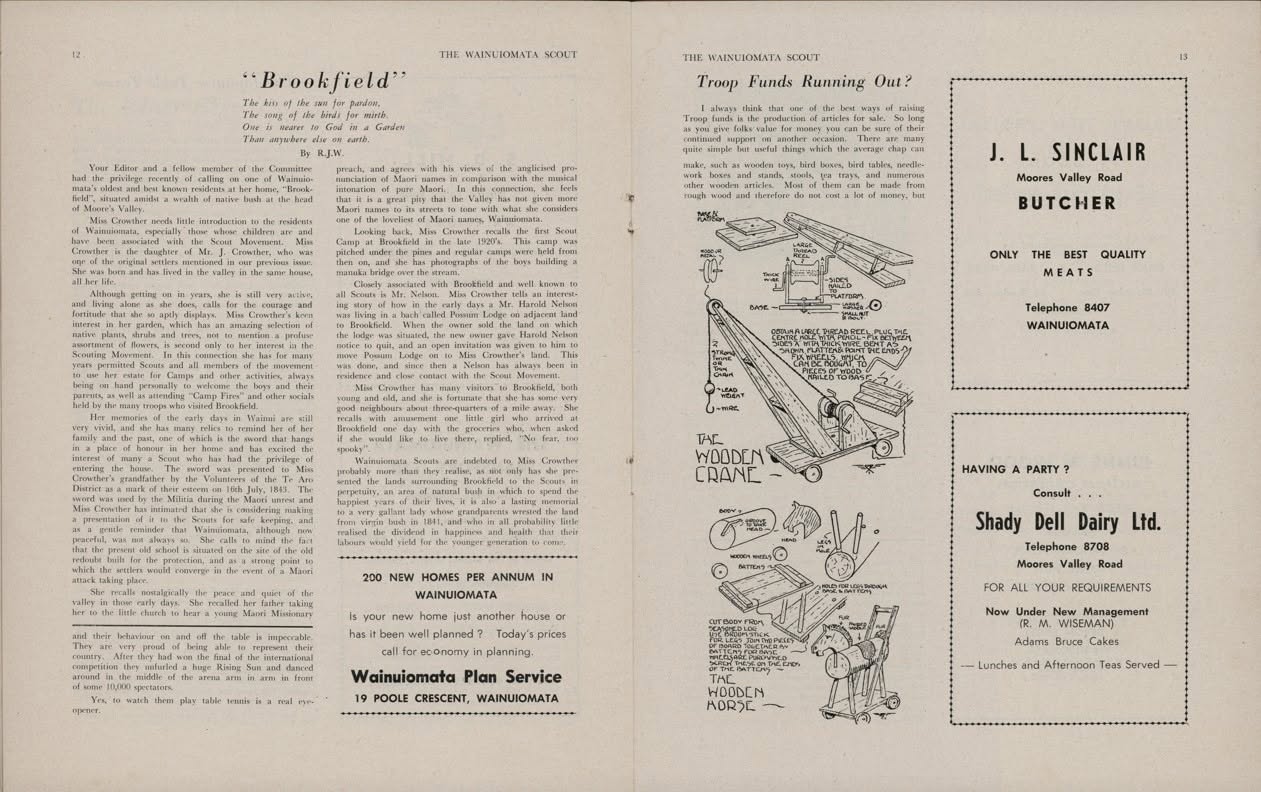
I always think that one of the best ways of raising Troop funds is the production of articles for sale. So long as you give folks value for money you can be sure of their continued support on another occasion. There are many quite simple but useful things which the average chap can make, such as wooden toys, bird boxes, bird tables, needle-work boxes and stands, stools, tea trays, and numerous other wooden articles. Most of them can be made from rough wood and therefore do not cost a lot of money, but—
THE WOODEN CRANE
Large thread reel
Thick wire
Sides nailed to platform
Base
2 strand rope or thin chain
Lead weight
Wire
THE WOODEN HORSE
Body
Horse head
Wooden wheels
Battery
Legs
Hole for long bearing rod in body
J. L. SINCLAIR
Moores Valley Road
BUTCHER
ONLY THE BEST QUALITY
MEATS
Telephone 8407
WAINUIOMATA
HAVING A PARTY?
Consult . . .
Shady Dell Dairy Ltd.
Telephone 8708
Moores Valley Road
FOR ALL YOUR REQUIREMENTS
Now Under New Management
(R. M. WISEMAN)
Adams Bruce Cakes
— Lunches and Afternoon Teas Served —
Pages 14-15
A Scout Is Thrifty
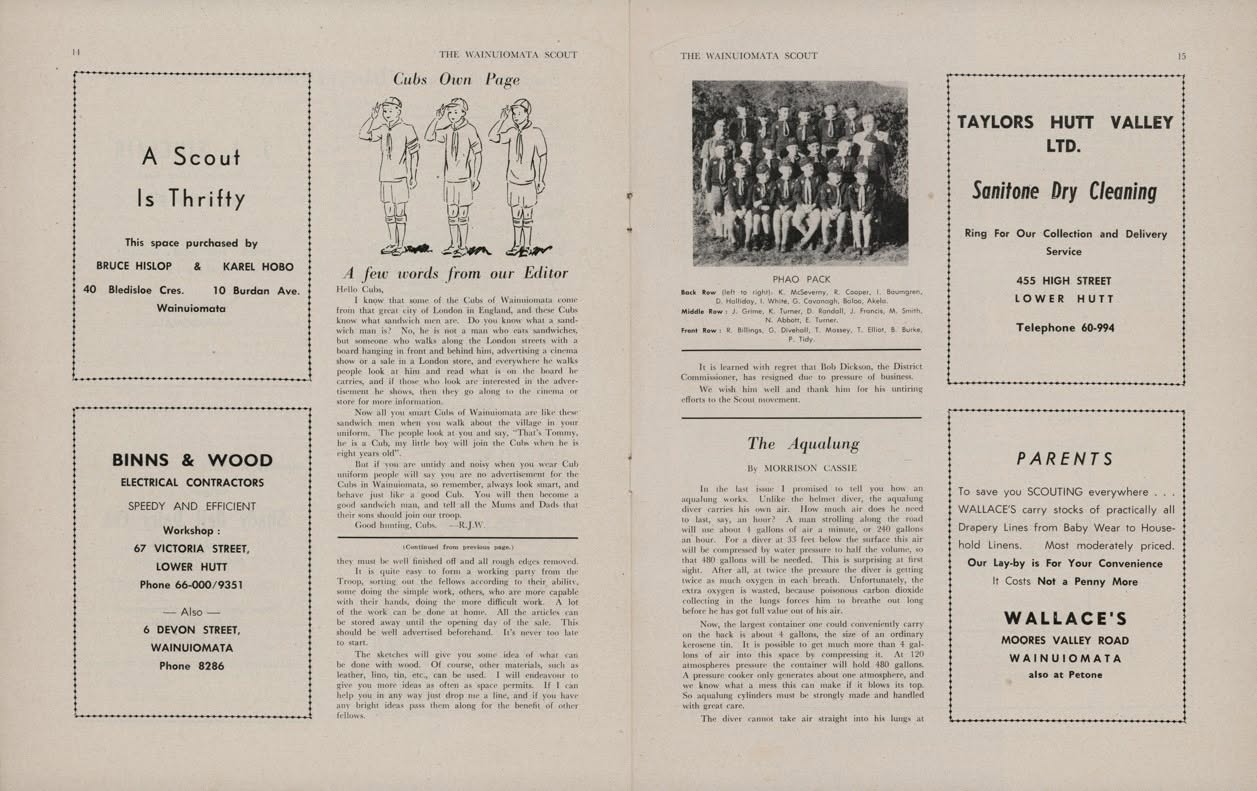 This space purchased by
BRUCE HISLOP & KAREL HOBO
40 Bledisloe Cres. 10 Burdan Ave.
Wainuiomata
BINNS & WOOD
ELECTRICAL CONTRACTORS
SPEEDY AND EFFICIENT
Workshop:
67 VICTORIA STREET,
LOWER HUTT
Phone 66-000/9351
— Also —
6 DEVON STREET,
WAINUIOMATA
Phone 8286
Cubs Own Page
A few words from our Editor
Hello Cubs,
I know that some of the Cubs of Wainuiomata come from that great city of London in England, and these Cubs know what sandwich men are. Do you know what a sandwich man is? No, he is not a man who eats sandwiches, but someone who walks along the London streets with a board hanging in front and behind him, advertising a cinema show or a sale in a London store, and everywhere he walks people look at him and read what is on the board he carries, and if those who look are interested in the advertisement he shows, then they go along to the cinema or store for more information.
Now all you smart Cubs of Wainuiomata are like these sandwich men when you walk about the village in your uniform. The people look at you and say, “That’s Tommy, he is a Cub, my little boy will join the Cubs when he is eight years old”.
But if you are untidy and noisy when you wear Cub uniform people will say you are no advertisement for the Cubs in Wainuiomata, so remember, always look smart, and behave just like a good Cub. You will then become a good sandwich man, and tell all the Mums and Dads that their sons should join our troop.
Good hunting, Cubs. —R.J.W.
they must be well finished off and all rough edges removed.
It is quite easy to form a working party from the Troop, sorting out the fellows according to their ability, some doing the simple work, others, who are more capable with their hands, doing the more difficult work. A lot of the work can be done at home. All the articles can be stored away until the opening day of the sale. This should be well advertised beforehand. It’s never too late to start.
The sketches will give you some idea of what can be done with wood. Of course, other materials, such as leather, lino, tin, etc., can be used. I will endeavour to give you more ideas as often as space permits. If I can help you in any way just drop me a line, and if you have any bright ideas pass them along for the benefit of other fellows.
PHAO PACK
Back Row (left to right): K. McSeverny, B. Cooper, I. Baumgren, D. Halliday, I. White, G. Cavanagh, Baloo, Akela.
Middle Row: J. Grime, K. Turner, D. Randall, J. Francis, M. Smith, N. Abbott, E. Turner.
Front Row: R. Billings, G. Overholt, T. Massey, T. Elliot, B. Burke, P. Tidy.
It is learned with regret that Bob Dickson, the District Commissioner, has resigned due to pressure of business.
We wish him well and thank him for his untiring efforts to the Scout movement.
The Aqualung
By MORRISON CASSIE
In the last issue I promised to tell you how an aqualung works. Unlike the helmet diver, the aqualung diver carries his own air. How much air does he need to last, say, an hour? A man strolling along the road will use about 4 gallons of air a minute, or 240 gallons an hour. For a diver at 33 feet below the surface this air will be compressed by water pressure to half the volume, so that 480 gallons will be needed. This is surprising at first sight. After all, at twice the pressure the diver is getting twice as much oxygen in each breath. Unfortunately, the extra oxygen is wasted, because poisonous carbon dioxide collecting in the lungs forces him to breathe out long before he has got full value out of his air.
Now, the largest container one could conveniently carry on the back is about 4 gallons, the size of an ordinary kerosene tin. It is possible to get much more than 4 gallons of air into this space by compressing it. At 120 atmospheres pressure the container will hold 480 gallons. A pressure cooker only generates about one atmosphere, and we know what a mess this can make if it blows its top. So aqualung cylinders must be strongly made and handled with great care.
The diver cannot take air straight into his lungs at—
TAYLORS HUTT VALLEY LTD.
Sanitone Dry Cleaning
Ring For Our Collection and Delivery
Service
455 HIGH STREET
LOWER HUTT
Telephone 60-994
PARENTS
To save you SCOUTING everywhere . . .
WALLACE’S carry stocks of practically all Drapery Lines from Baby Wear to Household Linens. Most moderately priced.
Our Lay-by is For Your Convenience
It Costs Not a Penny More
WALLACE’S
MOORES VALLEY ROAD
WAINUIOMATA
also at Petone
Pages 16-17
The Aqualung
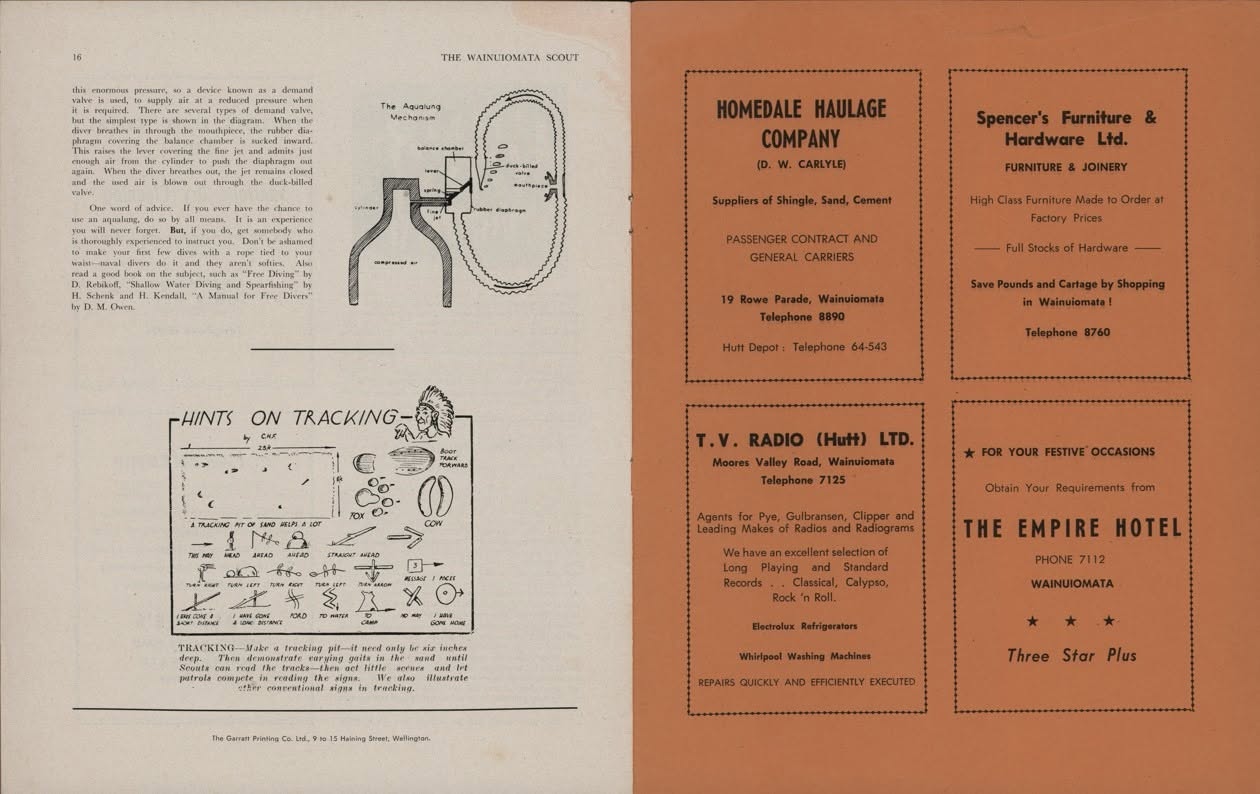 this enormous pressure, so a device known as a demand valve is used, to supply air at a reduced pressure when it is required. There are several types of demand valve, but the simplest type is shown in the diagram. When the diver breathes in through the mouthpiece, the rubber diaphragm covering the balance chamber is sucked inward. This raises the lever covering the fine jet and admits just enough air from the cylinder to push the diaphragm out again. When the diver breathes out, the jet remains closed and the used air is blown out through the duck-billed valve.
One word of advice. If you ever have the chance to use an aqualung, do so by all means. It is an experience you will never forget. But, if you do, get somebody who is thoroughly experienced to instruct you. Don’t be ashamed to make your first few dives with a rope tied to your waist—naval divers do it and they aren’t softies. Also read a good book on the subject, such as “Free Diving” by D. Rebikoff, “Shallow Water Diving and Spearfishing” by H. Schenck and H. Kendall, “A Manual for Free Divers” by D. M. Owen.
The Aqualung Mechanism
- balance chamber
- lever
- spring
- fine jet
- rubber diaphragm
- duck-billed valve
- mouthpiece
- cylinder
- compressed air
HINTS ON TRACKING
FOX
COW
BOOT TRACK FORWARDS
THIS WAY
AHEAD
STRAIGHT AHEAD
TURN RIGHT
TURN LEFT
BACK ARROW
FORD
TO WATER
TO CAMP
NO ROAD
TRACKING
Make a tracking pit—it need only be six inches deep. Then demonstrate varying gaits in the sand until Scouts can read the tracks—then get little groups and let patrols compete in reading the signs. We also illustrate other conventional signs in tracking.
The Garratt Printing Co. Ltd., 9 to 15 Haining Street, Wellington.
HOMEDALE HAULAGE COMPANY
(D. W. CARLYLE)
Suppliers of Shingle, Sand, Cement
PASSENGER CONTRACT AND
GENERAL CARRIERS
19 Rowe Parade, Wainuiomata
Telephone 8890
Hutt Depot: Telephone 64-543
Spencer’s Furniture & Hardware Ltd.
FURNITURE & JOINERY
High Class Furniture Made to Order at
Factory Prices
— Full Stocks of Hardware —
Save Pounds and Cartage by Shopping
in Wainuiomata!
Telephone 8760
T.V. RADIO (Hutt) LTD.
Moores Valley Road, Wainuiomata
Telephone 7125
Agents for Pye, Gulbransen, Clipper and
Leading Makes of Radios and Radiograms
We have an excellent selection of
Long Playing and Standard
Records . . . Classical, Calypso,
Rock ’n Roll.
Electrolux Refrigerators
Whirlpool Washing Machines
REPAIRS QUICKLY AND EFFICIENTLY EXECUTED
★ FOR YOUR FESTIVE OCCASIONS
Obtain Your Requirements from
THE EMPIRE HOTEL
PHONE 7112
WAINUIOMATA
★ ★ ★
Three Star Plus
Pages 18
Vision, skill and, perseverance
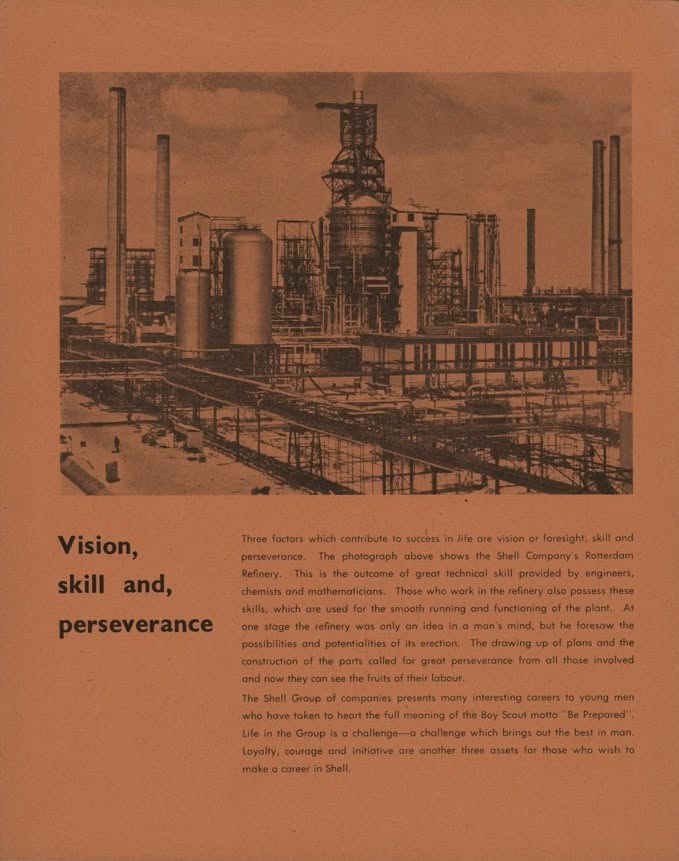 Three factors which contribute to success in life are vision or foresight, skill and perseverance. The photograph above shows the Shell Company’s Rotterdam Refinery. This is the outcome of great technical skill provided by engineers, chemists and mathematicians. Those who work in the refinery also possess these skills, which are used for the smooth running and functioning of the plant. At one stage the refinery was only an idea in a man’s mind, but he foresaw the possibilities and potentialities of its erection. The drawing up of plans and the construction of the parts called for great perseverance from all those involved and now they can see the fruits of their labour.
The Shell Group of companies presents many interesting careers to young men who have taken to heart the full meaning of the Boy Scout motto “Be Prepared”. Life in the Group is a challenge—a challenge which brings out the best in man. Loyalty, courage and initiative are another three assets for those who wish to make a career in Shell.




)