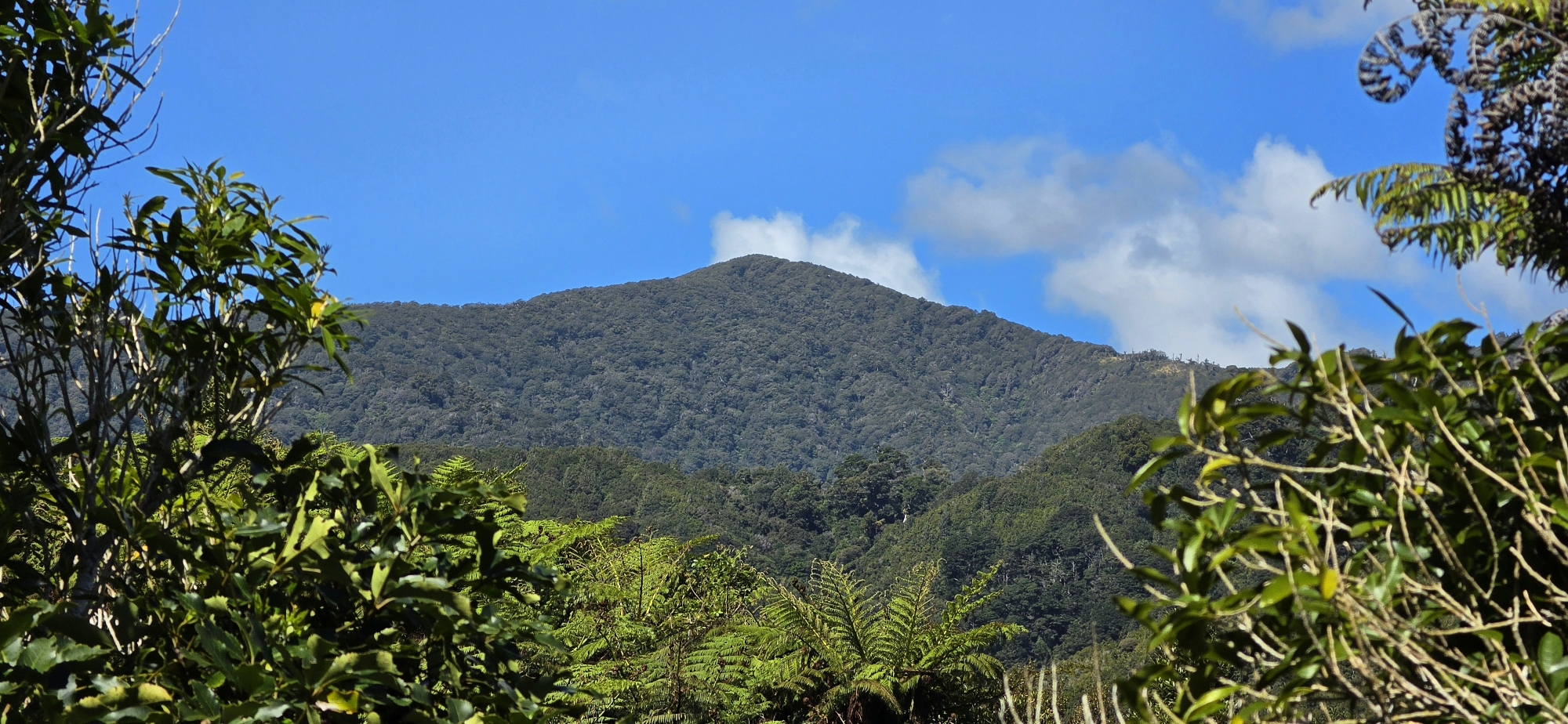
Puketahā is a prominent mountain ridge rising above the Wainuiomata water catchment, forming part of the western side of the Remutaka Range. The ridge forms a natural boundary between the Wainuiomata water catchment to the west and the Ōrongorongo catchment to the east. Its forested slopes are part of the mountainous skyline visible from Wainuiomata and across Wellington Harbour.
Puketahā Peak
Its named summit, Puketahā Peak, stands at 767 metres above sea level, near the headwaters of Sinclair Creek. Surrounded by dense native forest, the peak rises above the Wainuiomata and Ōrongorongo water catchments, with steep, bush-covered slopes descending into the valleys below. Despite its elevation, the summit offers virtually no views because of the surrounding vegetation.
The Puketahā Ridge
Although Puketaha is marked as an individual peak on topographical maps, the name Puketahā also refers to a wider mountain ridge extending approximately three kilometres.
According to Taranaki Whānui ki te Upoko o te Ika, this pae maunga (mountain range) contains three principal summits, rising to 800, 767 and 791 metres respectively, from south to north.
Name and History
Puketahā is a Māori name with considerable cultural significance to Taranaki Whānui. In a 2021 cultural report, the iwi described the name as meaning “hill of calabashes” and identified the mountain as one of its ancestral maunga.
The name has a long history on local maps. Puketaha appears among the named geographical features on James Daniel Climie’s 1882 topographical map of Wainuiomata.
It was also mentioned in an Evening Post article published on 12 November 1921, which described the principal peaks of the Remutaka and Ōrongorongo ranges. Puketaha was listed at 2,516 feet, equivalent to approximately 767 metres. It was mentioned by the same newspaper in 1909.
Water Catchment and Conservation
Puketahā overlooks extensive areas of native forest protected within the Wainuiomata and Ōrongorongo water collection areas. These forests help maintain water quality and provide important habitats for native plants and wildlife.
The mountain also gave its name to the proposed Puketahā Wainuiomata Ecosanctuary, an ambitious conservation project investigated by Greater Wellington Regional Council and Taranaki Whānui.
The proposal involved establishing a large predator-free sanctuary within the Wainuiomata water catchment, with the potential to reintroduce threatened native birds, including kākāpō.
Much of the surrounding catchment remains subject to restricted public access because of its importance to the Wellington region’s drinking water supply.